Non-residential building consents
Social and warehouse buildings boost January consents
1 Mar 2024

Our take on the latest Non-residential building consents (Fri 1 Mar 2024)
Value of non-res consents
$963m

In Jan 2024
Highest level of social building consents since April 2019
Warehouse consents up $101m from January 2023
The key numbers...
- There was $963m worth of non-residential consents issued in January 2024, roughly double their level in January 2023. Adjusted for seasonality and building cost inflation, monthly consents were at their highest level in eight months.
- The unusually high level of consents, which arrested a six-month streak of annual declines, was primarily driven by large increases in social (up $268m from January 2023), warehouse (up $101m) and hospital ($64m) building.
- Higher social consents were driven by a massive $225m worth of consents in Canterbury, and $36m in Otago. Warehouse consents totalled $100m in Auckland, up $88m from a year ago.
- On an annual basis, consent values continue to decline or flatten across most regions. The largest declines were in Nelson (down 32%pa over the year to January) and Southland (21%pa).
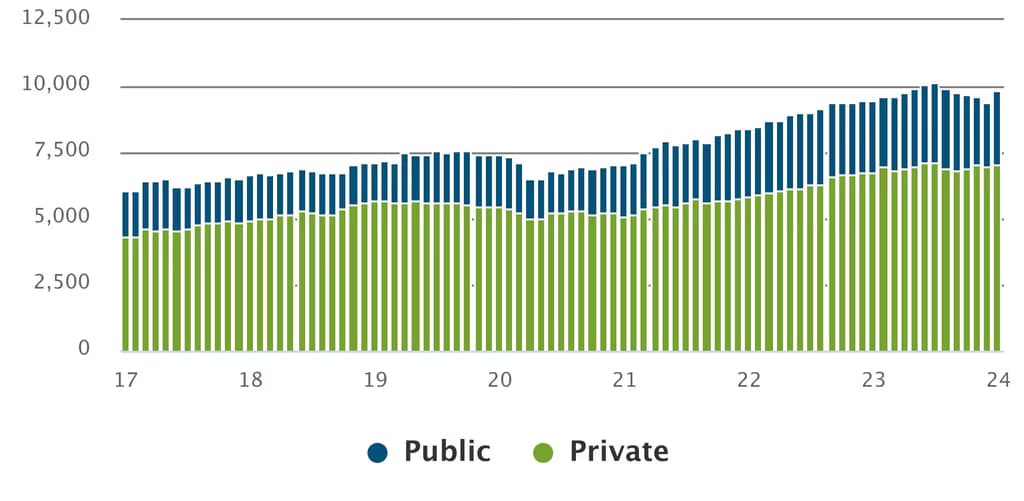
Strong boost to public consents in January
Annual running total, $m
...and our reaction
- January’s flurry of activity took annual consents to their highest level since September last year, despite strong headwinds in the sector from elevated interest rates and narrowing government spending.
- However, given the more localised nature of consenting (with social consents driven almost entirely by Canterbury, and warehouse consents driven by Auckland), January’s strength is likely to be a one-off, caused by select large projects. Canterbury’s pipeline of social building is notable, with developments across the Cathedral, Canterbury Museum, Robert McDougall Gallery, and Te Kaha arena all underway.
- Scope for further increases in public consents is limited, with local council budgets under significant pressure, and central government investment increasingly focused on hospital building.
- We expect consents to resume their downward trend over the next few months, particularly given the Reserve Bank’s recent statement that the “OCR needs to remain at a restrictive level for a sustained period of time”.
Latest updates
Premium

Non-residential building consents
Warehouses prevent further non-res falls in June
Mon 3 Aug 2026
Monthly
$701m Value of non-res consents in June 2026
 7.4% Total non-res consents from May 2026 (seas adj)37%pa Warehouse consents from June 2025
Premium
Non-residential building consents
Non-res consents weaker still in May
Thu 2 Jul 2026
Monthly
$789m Value of non-res consents in May 2026
19% Monthly consents from May 202549% Public sector consents from May 2025Non-residential building consents
Non-res consents mostly softer in April
Wed 3 Jun 2026
Monthly
$655m Value of non-res consents in April 2026
15% Monthly consents from April 2025 Office and education consents at lowest monthly levels in 5-6 years
Non-residential building consents
Consents strong in March, but shadow of conflict looms
Fri 1 May 2026
Monthly
$862m Value of non-res consents in March 2026
15% Monthly consents from Mar 2025$119m Hostel consents from Mar 2025