Residential building consents
Attached dwelling consents fall faster than houses
1 Mar 2024

Our take on the latest Residential building consents (Fri 1 Mar 2024)
Annual dwelling consents
36,453

As of January 2024
Total consents down 26%pa in year to January 2024
Total consents down 8.8% from December 2023
The key numbers...
- There were 1,991 new dwellings consented in January 2024, 8.8% fewer than December 2023 on a seasonally adjusted basis. Weaker consenting in January brought the annual total down to 36,453, accelerating the annual decline a further percentage point to 26%pa.
- The level of new dwellings consented in the year to January 2024 was last seen in the year to September 2019, which was still a high level at the time, but was surpassed with strong growth induced by low interest rates after the outbreak of COVID-19.
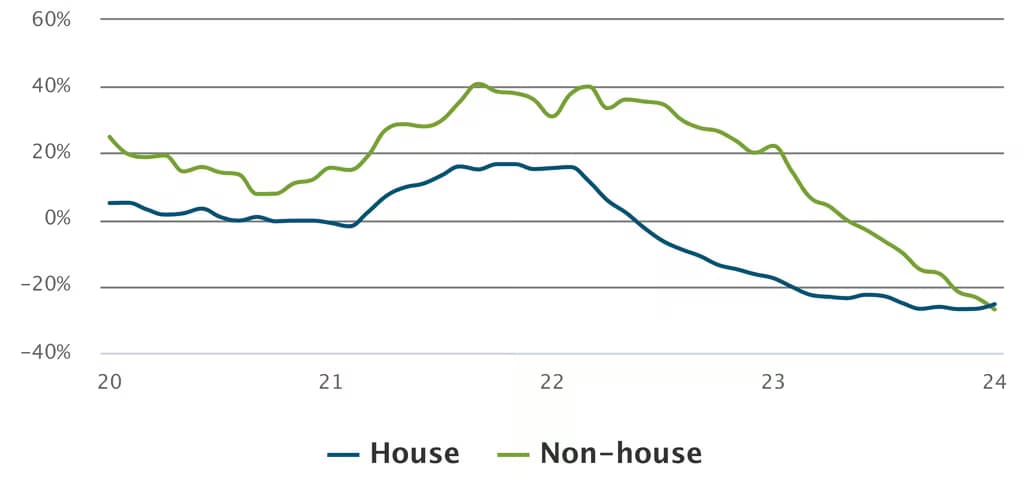
- Attached dwelling consents continue to decline faster than standalone consents. Year-end declines for standalone house consents have remained around 25-26%pa over the past few months, whereas year-end declines for attached dwellings accelerated from 23% to 27%pa between December 2023 and January 2024.
- The fall in attached housing consents has been driven by declines in Auckland, with a 33% decrease in attached consents in Auckland over the year to January 2024, compared to a 19% pull back across the rest of New Zealand.
- Total consents continue to decline fastest in Tasman, with a 46% fall in consents in the year to January 2024. Wellington follows closely behind, with a 41% in consents, amounting to 1,590 fewer dwellings compared to the prior year. Wellington’s fall is led by attached dwellings, falling 46%, although standalone houses fell by a fairly severe 30% too.
Non-house consents now falling faster than houses
New dwelling consents, annual average % change
...and our reaction
- The ongoing decline in residential consents has brought consent levels back to pre-pandemic levels, and the pace of declines continues to accelerate. Elevated build costs, higher interest rates, and yet-to-recover house prices continue to discourage investment in new housing.
- This month marks a notable milestone, with non-house consents now declining faster than houses. Non-houses have driven the increase in overall consenting since before the pandemic, and coupled with a challenging housing market and developer financing, we are unsurprised to now see a correction in non-house consents. Non-house accounts accounted for less than half of total consents in January, for the first time in two years.
- January marks a notable milestone, with non-house consents now declining faster than houses. Attached dwellings, which are generally the more affordable option, have held up better than houses during the last two years of residential declines. However, increasingly difficult financing conditions and a sluggish recovery in the housing market are now sending this consent type into free-fall.
- We expect further softening in both house and non-house consents in coming months, but the pace of decline is likely to slow down. Pressure on house prices from record high net migration, coupled with incoming interest rate relief by mid-late 2024, should see consent numbers plateau over the second half of the year.
Latest updates
Premium

Residential building consents
Residential consents fall 3.6% in June
Mon 3 Aug 2026
Monthly
40,581 Annual consents over the June 2026 year
 19% June 2026 consents over the June 2026 year3.6% June 2026 consents from May on a seas. adj. basis
Premium
Residential building consents
Residential consents fall 4.0% in May
Thu 2 Jul 2026
Monthly
 39,737 Annual consents over May 2026 year4.0% May 2026 consents from April on a seas. adj. basis22%pa Townhouse consents over May 2026 year
Residential building consents
Residential consents jump up 11% in April
Wed 3 Jun 2026
Monthly
39,087 Annual consents over April 2026 year11% April 2026 consents from March on a seas. adj. basis19%pa Multi-unit consents over April 2026 yearResidential building consents
Residential consent momentum trends sideways
Fri 1 May 2026
Monthly
37,813 Annual consents over March 2026 year 3,300pm Consents trend sideways on a seas. adj. basis14%pa Townhouse consents over March 2026 year