
Our take on the latest Employment indicators (Wed 28 Feb 2024)

Filled jobs up 0.6% in January (seasonally adjusted)
Growth in earnings per filled job rises above 6%pa
Filled jobs in health care up 15,455pa
The key numbers...
- Filled jobs rose an estimated 0.6% in January 2024 from the previous month. Employment in service industries rose 0.7%, with smaller increases in goods-producing (0.3%) and primary industries (0.2%, all figures seasonally adjusted).
- Health care and education continue to drive persistently strong growth in total filled job numbers, as these industries are expanding not only rapidly, but also at a faster rate compared to a year ago. Filled jobs in health care rose 15,455pa in January 2024, and filled jobs in education rose 8,852pa.
- Filled jobs in professional services fell 1.0% from January 2023, marking the sixth consecutive month of annual declines. Retail jobs recorded negative growth for the first time in over a year, easing 0.2% from January 2023.
- Earnings inflation accelerated to 6.2%pa in January, the fastest rate since May 2023. The biggest acceleration was in service industries, rising from 6.0%pa in December 2023, to 6.6%pa, although wage pressures intensified in primary and goods-producing industries as well.
Jobs growth continues to level off in January
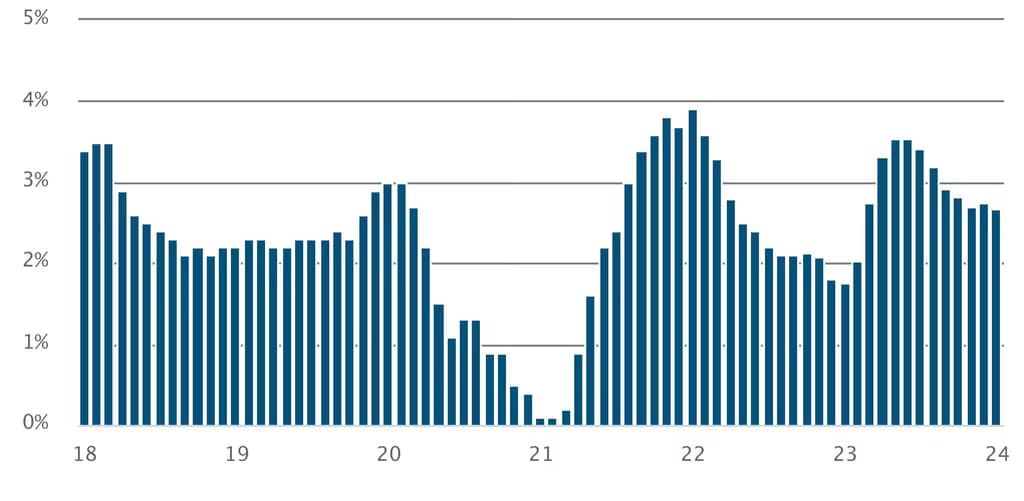
Filled jobs, 3-month annual % change
...and our reaction
- Labour market momentum in January was again surprisingly strong. Sustained growth over the last few months has seen three-month annual growth to plateau at around 2.7%pa, rather than decelerate.
- Growth in health care and education picked up at the end of 2023, despite slowing down between May and October last year. Strong growth was sustained into January, preventing further slowdown in the broader labour market. However, the new government’s more narrow spending focus should see some heat come out of growth in these industries into 2024.
- Jobs growth is decelerating across most other industries. In particular, the decline in retail trade jobs illustrates the real impact of lower economic activity on hiring decisions. Job advertisements declined 24%pa in January as demand for labour continues to ease.
- Persistent earnings inflation across all sectors hints at the risks of continued tightness in the labour market. Accelerated public sector labour costs, driven by a catch-up period following the Covid pay freeze and recent collective agreements for teachers and nurses, have also contributed to strong growth in service industry earnings.
- Albeit gradually, labour market tightness is easing. With net migration still massively elevated, unemployment at its highest rate in 2½ years, and job ads continuing to decline, we expect momentum in both jobs and earnings growth will slow this year.
Latest updates
Premium

Employment indicators
Further weak employment recovery
Tue 28 Jul 2026
Monthly
 0.1% Filled jobs rose in June 2026 (sa)0.6%pa Filled jobs were up from June 20251.5%pa South Island filled jobs incre from June 2025
Premium
Employment indicators
Public sector leads job gains
Mon 29 Jun 2026
Monthly
0.3% Filled jobs in May (sa) 0.1% Filled jobs in April (sa)0.7% Filled jobs from May 2025
Employment indicators
Healthcare leads job growth
Thu 28 May 2026
Monthly
0.2% Filled jobs in April (sa)0.5% Filled jobs from April 20255,527 Healthcare jobs over the year to AprilEmployment indicators
Let’s hear it for the South
Tue 28 Apr 2026
Monthly
0.3% Filled jobs in March (sa)0.2% Filled jobs in February (sa)1.5%pa South Island jobs in March