Residential building consents
Falling attached dwelling consents accelerate residential decline
2 Feb 2024

Our take on the latest Residential building consents (Fri 2 Feb 2024)
Annual dwelling consents
37,239

As at December 2023
Total consents down 27%pa in December quarter
Non-house consent declines accelerate to 23%pa
The key numbers...
- There were 2,487 dwelling consents in December 2023, taking the annual total to 37,239. The year-end decline accelerated to 25%pa, the steepest drop since 2009.
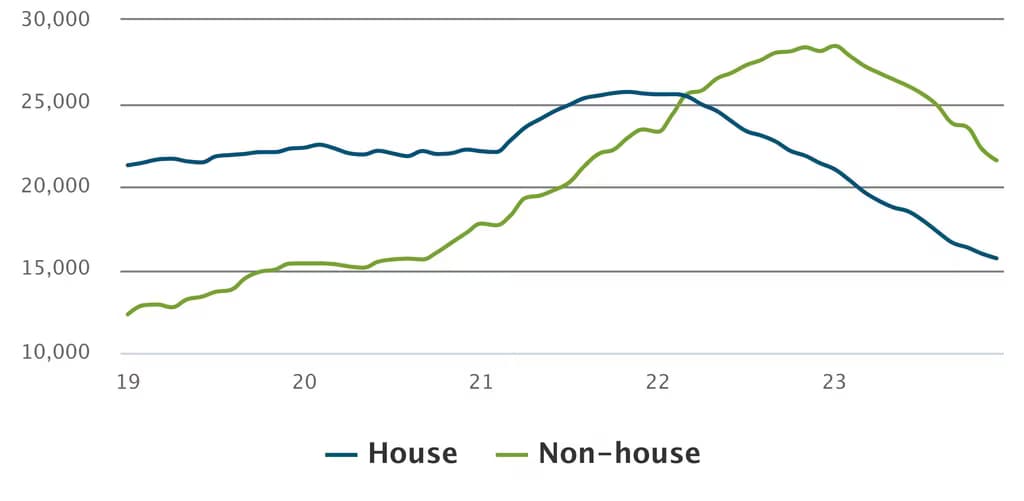
- This more rapid decline was driven by worsening numbers of attached dwelling consents. Year-end declines in standalone house consents have stabilised at around 26-27%pa since September last year, but non-house consent declines have accelerated from 15%pa in September to 23% by December.
- The biggest contributions to the fall in townhouse consents, which make up the vast majority of non-house consents, have come from Auckland (-30%pa in the December quarter), Wellington (-47%pa), and Canterbury (-14%pa).
- Tasman has seen the sharpest drop-off in total consents, with three-month annual declines consistently over 50%pa since August. Growth in Gisborne has remained fairly robust, with consents increasing 28%pa in the December quarter – although this growth is relative to a particularly weak December 2022 quarter. The same is true of Hawke’s Bay and Nelson, where growth is positive, but from a low base.
House consents decline steadily as non-house downturn worsens
Consents by dwelling type, annual running total
...and our reaction
- The residential consent downturn is well underway, with high building costs and interest rates continuing to kill appetite for new builds. Total consent numbers for the December quarter came in 126 (or 1.5%) below the estimate published this morning in our February Building Forecasts, with townhouses falling 190 consents (or 4.8%) short of expectations.
- The worsening decline in non-house consents suggests that financing constraints are weighing on the ability of developers to go ahead with projects, with banks having tightened their lending criteria. Attached dwellings had previously increased their share of total consents throughout the downturn by holding up better than houses. However, the sharper decline of attached dwelling consents has seen their share of the total edge down from a peak of 60% in the September quarter, to 55%.
- We expect residential construction intentions to continue weakening over the next few months. However, some relief is on the horizon. The definitive moderation in headline inflation should enable to Reserve Bank to begin cutting interest rates earlier than expected, and high net migration will maintain demand-side pressure on house prices. Together, these factors should help consent numbers to plateau over the second half of 2024.
Latest updates
Premium

Residential building consents
Residential consents fall 3.6% in June
Mon 3 Aug 2026
Monthly
40,581 Annual consents over the June 2026 year
 19% June 2026 consents over the June 2026 year3.6% June 2026 consents from May on a seas. adj. basis
Premium
Residential building consents
Residential consents fall 4.0% in May
Thu 2 Jul 2026
Monthly
 39,737 Annual consents over May 2026 year4.0% May 2026 consents from April on a seas. adj. basis22%pa Townhouse consents over May 2026 year
Residential building consents
Residential consents jump up 11% in April
Wed 3 Jun 2026
Monthly
39,087 Annual consents over April 2026 year11% April 2026 consents from March on a seas. adj. basis19%pa Multi-unit consents over April 2026 yearResidential building consents
Residential consent momentum trends sideways
Fri 1 May 2026
Monthly
37,813 Annual consents over March 2026 year 3,300pm Consents trend sideways on a seas. adj. basis14%pa Townhouse consents over March 2026 year