Employment indicators
Jobs and earnings momentum surprisingly strong in December
29 Jan 2024

Our take on the latest Employment indicators (Mon 29 Jan 2024)


Filled jobs up 0.2% in December (seasonally adjusted)
Growth in earnings per filled job rises above 5%pa again
Construction employment picks up to a 16-month high
The key numbers...
- Filled jobs rose 0.2% in December from the month before (seasonally adjusted), driven largely by a 0.4% increase in service industries employment. Filled jobs in good-producing industries rose 0.1%, but primary industry jobs eased 1.8%.
- Employment growth accelerated across most industries in December, with notable rises in health care, construction, and education. Jobs growth in health care picked up to its fastest rate since late-2021, and construction jobs growth reached a 16-month high.
- Professional services jobs numbers continued to fall in December, but the pace of decline eased to 0.6%pa. Retail trade jobs growth remained low at 0.6%pa.
- Jobs growth picked up across all age groups except 15-19-year-olds (where declines steepened to 9.9%pa). Growth across all five-year subgroups between 30 and 49 years old accelerated to its fastest rate since the series began in 2019.
- Annual growth in earnings per filled job picked up from 4.8%pa in November to 5.6%pa, with wage inflation rising slightly across the primary, goods-producing, and service sectors.
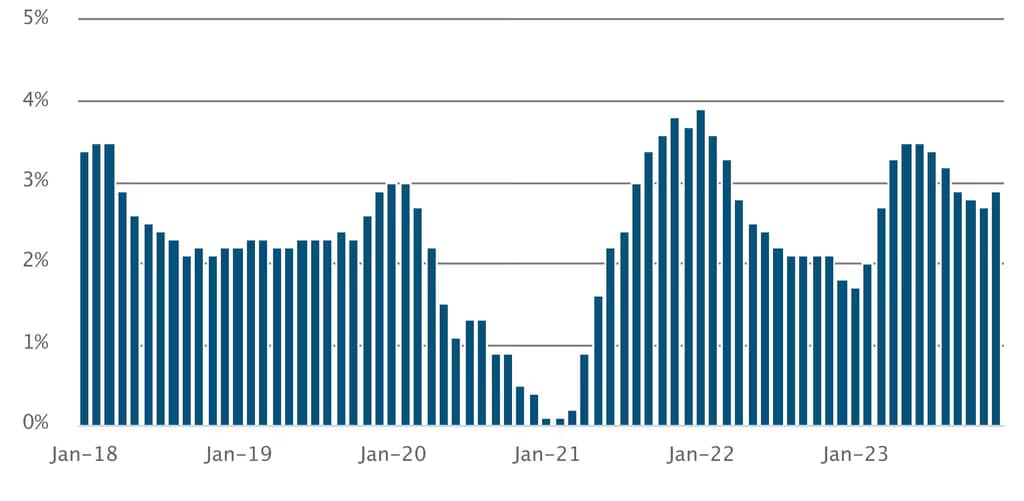
Jobs growth picks up in December
Filled jobs, 3-month annual % change
...and our reaction
- Although December’s result represents stronger labour market momentum compared to the previous few months, jobs growth and wage inflation are still considerably below the rates seen in early 2023.
- With just one month of data, December’s strong result could potentially be a blip in the broader slowdown. Renewed growth in the health, education, and construction sectors was unexpected, given that growth had been generally tailing off over the latter half of 2023.
- Earnings growth still hovering around 5%pa indicates that the labour market is still tight, although fewer job ads and greater ease for businesses in finding staff point to a general softening in wage inflation during 2024.
- Jobs growth could remain lumpy over the next few months – annual net migration grew at a record pace over 2023, and is still flowing through to stronger job numbers. However, we anticipate that net migration has reached a peak and will come down over 2024 as demand for labour eases, with these trends to be reflected by less momentum in jobs growth.
Latest updates
Premium

Employment indicators
Further weak employment recovery
Tue 28 Jul 2026
Monthly
0.1% Filled jobs rose in June 2026 (sa)0.6%pa Filled jobs were up from June 20251.5%pa South Island filled jobs incre from June 2025Premium
Employment indicators
Public sector leads job gains
Mon 29 Jun 2026
Monthly
0.3% Filled jobs in May (sa) 0.1% Filled jobs in April (sa)0.7% Filled jobs from May 2025
Employment indicators
Healthcare leads job growth
Thu 28 May 2026
Monthly
0.2% Filled jobs in April (sa)0.5% Filled jobs from April 20255,527 Healthcare jobs over the year to AprilEmployment indicators
Let’s hear it for the South
Tue 28 Apr 2026
Monthly
0.3% Filled jobs in March (sa)0.2% Filled jobs in February (sa)1.5%pa South Island jobs in March