
Our take on the latest Employment indicators (Wed 10 Jan 2024)


Filled jobs up 0.1% in November (seas. adj.)
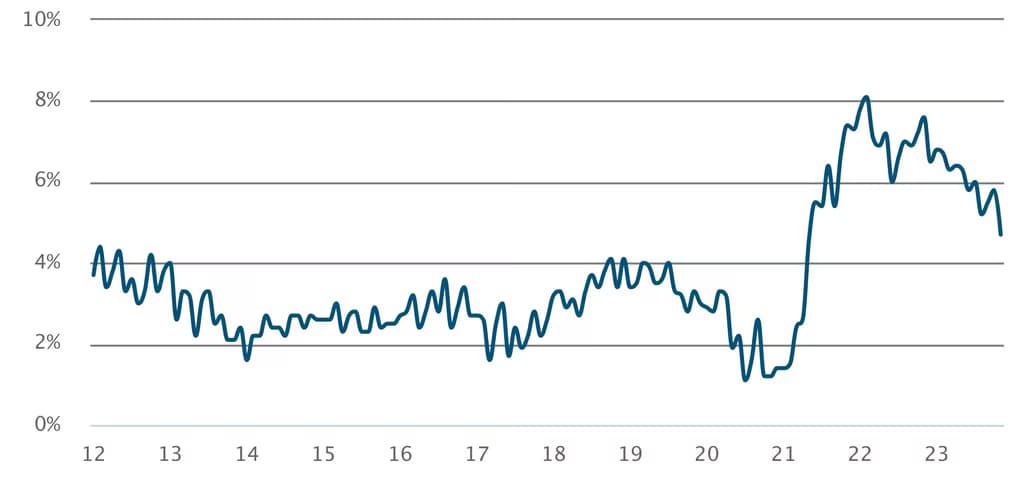
Growth in earnings per filled job slowed to below 5%pa
Stronger jobs growth in the Upper North Island
The key numbers...
- Filled job numbers rose 0.1% in November from the month before, driven by more workers in good-producing industries as well as more primary sector workers. Services jobs were broadly flat.
- Growth in earnings per filled job slowed back to 4.7%pa on average over the 12 months to November 2023, the first sub-5% result for this metric since the year ending May 2021 – having peaked at 8.1% over the February 2022 year and being above 6% until May 2023.
- Employment growth in November was faster in the North Island than in the South Island, compared to a year earlier, with these areas recording gains of 2.7%pa and 2.4%pa respectively. The Upper North Island was even stronger, at 3.3%pa.
- Public administration jobs remain higher, up 7.0% compared to November 2022, although some of this growth will be due to continued work in November by Electoral Commission workers undertaking the general election. Excluding the public administration and safety industry, employment growth has slowed from a recent high of 3.6%pa in March and April 2023 to 2.4%pa in November 2023.
- Strong employment growth continues to be recorded in the health sector, with a 5.5%pa increase in filled jobs. Some tourism sub-industries continue to recover too, with an 8.1% increase in arts and recreation jobs and a 7.6%pa rise in transport, postal and warehousing. However, accommodation and food services employment growth has slowed back to 4.1% from a peak of 13%pa earlier in 2023, and retail trade employment growth has slipped to just 0.3%pa.
Wage pressures easing, still elevated
Annual average % change
...and our reaction
- Momentum in employment continues to diminish, but there are still more jobs being added to the workforce, despite the slowdown in the wider economy.
- The slowdown in earnings per filled job growth reflects the labour market loosening from its tight stance earlier in 2022 and early 2023, with less of a war for talent reducing the pressure for higher wages from “high” to “moderate”.
- The different industry outcomes, in particular the slowdown in jobs growth in retail and accommodation and food services, highlights the uneven effects on spending (in the first instance) and employment (as a result of those spending outcomes) on the labour market. Industries whose sales are more interest-rate sensitive are seeing a sharper slowdown in employment growth as businesses in those industries don’t hire as many people, or indeed reduce staff.
- The stronger growth in filled jobs in the Upper North Island does highlight that there is a rising divergence between jobs opportunities in different parts of the country. Much of the recovery in tourism employment in the South Island has occurred, restraining the rates of growth in that part of the country, but growth in the Golden Diamond (Northland, Auckland, Bay of Plenty, and Waikato) remains stronger than the lower half of the North Island.
- Job ads are now 29% lower than a year ago and continue to fall, with job ads now sitting 13% lower than pre-pandemic levels. Slower employment growth confirms this trend, as does the trend number of work visas issued in late 2023 being 8.2% below the highs seen in March 2023. Combined, this slowdown in employment momentum means we still expect record high net migration levels to moderate in 2024
Latest updates
Premium

Employment indicators
Further weak employment recovery
Tue 28 Jul 2026
Monthly
 0.1% Filled jobs rose in June 2026 (sa)0.6%pa Filled jobs were up from June 20251.5%pa South Island filled jobs incre from June 2025
Premium
Employment indicators
Public sector leads job gains
Mon 29 Jun 2026
Monthly
0.3% Filled jobs in May (sa) 0.1% Filled jobs in April (sa)0.7% Filled jobs from May 2025
Employment indicators
Healthcare leads job growth
Thu 28 May 2026
Monthly
0.2% Filled jobs in April (sa)0.5% Filled jobs from April 20255,527 Healthcare jobs over the year to AprilEmployment indicators
Let’s hear it for the South
Tue 28 Apr 2026
Monthly
0.3% Filled jobs in March (sa)0.2% Filled jobs in February (sa)1.5%pa South Island jobs in March