
Our take on the latest Residential building consents (Fri 12 Jan 2024)
Annual dwelling consents

38,209 as at November 2023
Consents down 36% from November 2022
Standalone consents down 27%pa in year to November 2023
The key numbers...
- Dwelling consents in November were down 36% from November 2022, which was a relatively strong month. This fall brings annual dwelling consents to 38,209, down 24% from the year to November 2022. After adjusting for seasonal effects, total consents in November were down 11% from October.
- Dwelling consents continued to fall sharply in many regions, with declines over 30% on a three-monthly annual basis for Northland, Auckland, Waikato, Hawke’s Bay, Manawatū-Whanganui, Wellington and Tasman.
- Gisborne, Marlborough, and Nelson were the only regions to record an increase in dwelling consents in the last three months compared to a year before.
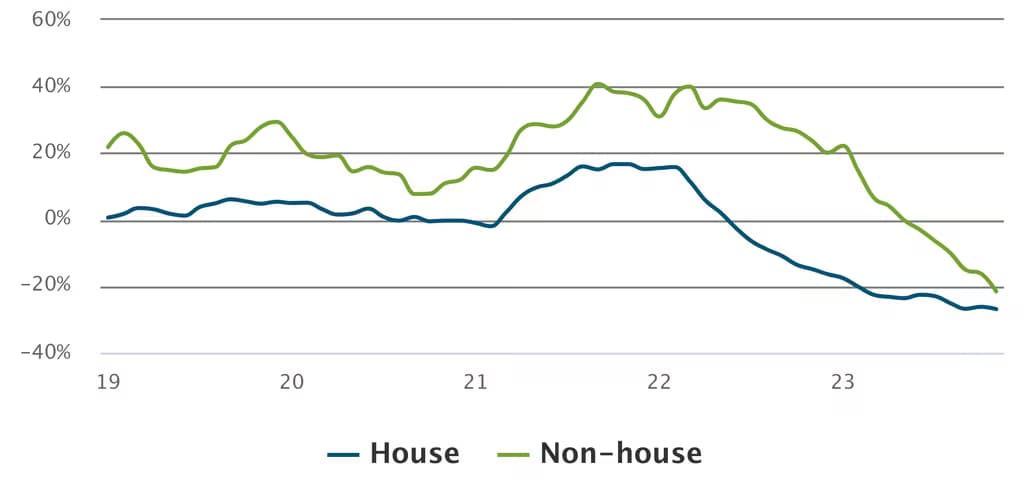
- Standalone house consents continue to bear the brunt of the annual consent downturn, falling 27% over the year to November 2023, with attached dwelling consents falling by a lesser 22%. However, this attached dwelling fall is the steepest fall this cycle, driven by a 47% fall in November attached dwelling consents, compared to November 2022.
- Consents for townhouses declined faster in November, down 31% from November 2022, compared to a 16% decline in October. The decline in townhouse consents was driven by a 41% fall in Auckland, which accounts for over half of all townhouse consents. Consents fell by a lesser 26% in Canterbury, the second largest region for townhouse consents.
Non-house consents rose faster, falling slower
New dwelling consents, annual average % change
...and our reaction
- Residential consents continue to decline, in line with our expectations. So far, annual consents have declined from a peak of just over 51,000pa over the year to May 2022, a 25% drop so far.
- The fall in consents remains broad-based across New Zealand, with most areas, and certainly the larger areas for building, recording consistent declines.
- Although attached dwelling consents have risen faster than standalone house consents since 2020, standalone houses have borne the brunt of the downturn so far – starting their decline earlier, and falling further.
- As a result, attached dwellings continue to grow their share of total dwellings – at 58% in the year to November 2023. Ten years ago, attached dwellings’ share was 22% - illustrating just how much residential typologies have shifted.
- The recent sharper decline in attached dwellings is worth noting, and something we will be watching closely in the future around any further changes to the composition of residential building activity. November was a poor result, but we’d want more than one month of data to determine if there’s a change in trend rather than just volatility around more lumpy attached dwelling options.
Latest updates
Premium

Residential building consents
Residential consents fall 3.6% in June
Mon 3 Aug 2026
Monthly
40,581 Annual consents over the June 2026 year
 19% June 2026 consents over the June 2026 year3.6% June 2026 consents from May on a seas. adj. basis
Premium
Residential building consents
Residential consents fall 4.0% in May
Thu 2 Jul 2026
Monthly
 39,737 Annual consents over May 2026 year4.0% May 2026 consents from April on a seas. adj. basis22%pa Townhouse consents over May 2026 year
Residential building consents
Residential consents jump up 11% in April
Wed 3 Jun 2026
Monthly
39,087 Annual consents over April 2026 year11% April 2026 consents from March on a seas. adj. basis19%pa Multi-unit consents over April 2026 yearResidential building consents
Residential consent momentum trends sideways
Fri 1 May 2026
Monthly
37,813 Annual consents over March 2026 year 3,300pm Consents trend sideways on a seas. adj. basis14%pa Townhouse consents over March 2026 year