Residential building consents
Smaller fall but dwelling consents still declining
30 Nov 2023

Our take on the latest Residential building consents (Thu 30 Nov 2023)
Annual dwelling consents
39,900

As at October 2023
Consents down 14% from October 2022
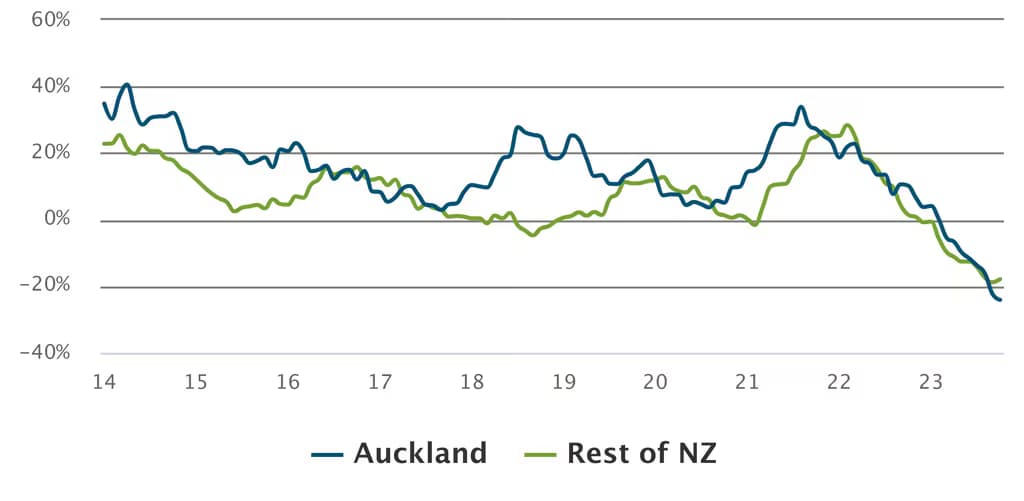
Auckland consents down 36%pa in last three months
The key numbers...
- Dwelling consent numbers in October were down 14% from a year ago, which was the smallest annual decline since January. However, the annual consent total is now below 40,000 for the first time since February 2021.
- After adjusting for seasonal effects, October’s consent total was up 8.8% from September, reinforcing that the latest month’s result was less negative than in previous months.
- Standalone house consents last month were down 19% from October 2022, which was an improvement from the declines of more than 30% during the last three months.
- Sharp declines in house consents of more than 25%pa continued in Hawke’s Bay, Bay of Plenty, Manawatū-Whanganui, Canterbury, Waikato, and Otago. In contrast, Northland, Taranaki, Nelson, and Marlborough issued more house consents in October than a year ago.
- Apartment and retirement unit consent numbers were both higher than in October last year. Apartment numbers were boosted by a record high month for consents in Canterbury (123), while Auckland, Wellington, and Canterbury accounted for over three-quarters of retirement units.
- The 16%pa fall in townhouse consents was the biggest annual drop since early 2012. Townhouse consents in Auckland for the three months to October were down by 26%pa, and Wellington and Waikato also made significant contributions to the weaker October result.
Auckland's consents now falling faster
New dwelling consents, year-end % change
...and our reaction
- Although October’s result is less negative than figures throughout the September quarter, the trend of weaker consent numbers continues to be in line with our forecasts.
- Auckland’s 36%pa decline in consents over the three months to October is the region’s biggest fall since early 2009, at the height of the Global Financial Crisis. However, levels of construction activity will be holding up better for now given the backlog of consents awaiting completion.
- Record-high net migration is boosting housing demand and leading to a pick-up in house prices and rents. Although we believe migration is close to peaking, if it persists at very high levels, it could put a floor under demand and start to stimulate more residential activity by the second half of 2024. These upside risks are most pronounced in Auckland, where a large proportion of new immigrants initially settle.
- At this stage, we continue to expect the residential consent total to ease towards 34,000pa by the end of next year.
Latest updates
Premium

Residential building consents
Residential consents rise 5.6% in August
Thu 1 Oct 2026
Monthly
41,268 Annual res consents over the August 2026 year
 21%pa Annual consents lifted over the August 2026 year5.6% August 2026 consents from July on a seas. adj. basis
Premium
Residential building consents
Residential consents fall 4.2% in July
Wed 2 Sept 2026
Monthly
40,908 Annual res consents over the July 2026 year
21%pa Annual consents lifted over the July 2026 year4.2% July 2026 consents from June on a seas. adj. basisResidential building consents
Residential consents fall 3.6% in June
Mon 3 Aug 2026
Monthly
40,581 Annual consents over the June 2026 year
19% June 2026 consents over the June 2026 year3.6% June 2026 consents from May on a seas. adj. basisResidential building consents
Residential consents fall 4.0% in May
Thu 2 Jul 2026
Monthly
 39,737 Annual consents over May 2026 year4.0% May 2026 consents from April on a seas. adj. basis22%pa Townhouse consents over May 2026 year