
Our take on the latest Retail trade survey (Fri 24 Nov 2023)

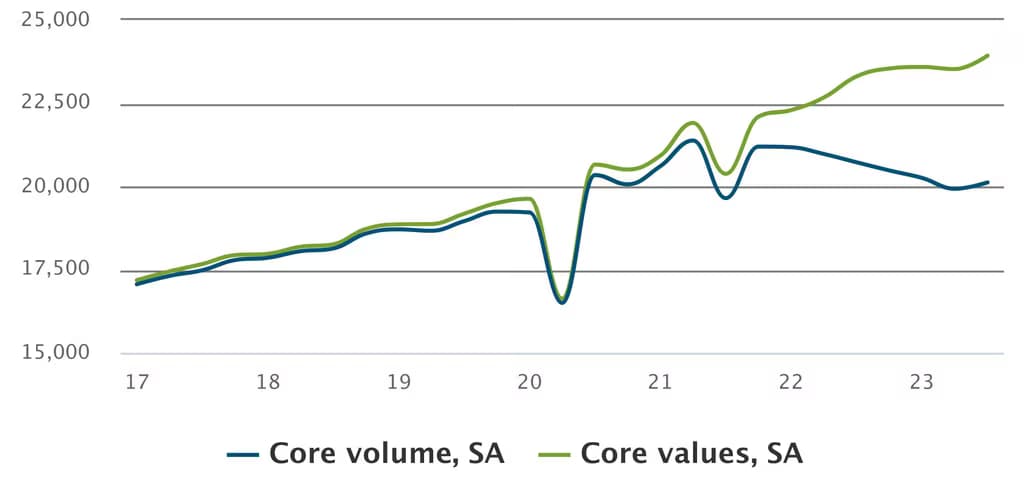
Core retail sales volumes up 1.0% from June 2023 quarter (seasonally adjusted)
Core sales values up 1.7% from June 2023 quarter (seasonally adjusted)
Volumes growth turns positive in supermarket and hardware retailing
The key numbers...
- Core retail sales volumes, which exclude motor vehicle and fuel retailing, rose 1.0% from the June 2023 quarter (seasonally adjusted). This result was the first quarterly increase since late 2021.
- Quarterly growth in supermarket and hardware supplies volumes turned positive in September after more than a year of declines, up 1.0% and 2.9% respectively. Volumes growth was also positive in clothing, recreational goods, and food and beverage services, after having declined in the June quarter.
- Spending volumes declined in homeware retailing, and department stores, motor vehicles, and fuel retailing.
- Total retail volumes (core plus the more volatile motor vehicles and fuel categories) in the September 2023 quarter were unchanged from the June quarter.
- Nominal spending values (without price adjustment) across core industries rose 1.7% from the June 2023 quarter (seasonally adjusted), driven by supermarket, hardware, and food and beverage services spending.
- The value of held stock eased for a third consecutive quarter (seasonally adjusted) but is still 11% above pre-pandemic levels.
Both volumes and values up in September
Retail sales, core measure, seasonally adjusted, $b
...and our reaction
- Retail activity was surprisingly buoyant in the September 2023 quarter, although persistent declines in the especially discretionary categories of homeware and department stores indicates that household budgets are still under pressure.
- Higher prices continue to add to the value of spending, and rapid population and employment growth is likely to be boosting both retail values and volumes. With overall spending volumes flat, despite the most rapid population growth this year since the 1950’s, per-person spending remains weak.
- Stubborn labour cost inflation (which was steady at 4.3%pa in the September quarter) coupled with easing consumer price inflation is also likely helping to keep household budgets above water.
- Today’s data does hint at a possible shift in spending priorities. More spending on supermarket, clothing, and food and beverage services could suggest households are becoming more willing to spend slightly more on smaller non-essentials at the expense of larger non-essentials. Purchasing extra food and clothing or going out to eat more are relatively small splurges, and therefore will be the first categories to turn around as consumer confidence improves from a low base. However, one quarter of data is not enough to say definitively whether sentiment has turned.
- Stock levels have been declining very slowly from their late 2022 peak, easing just 0.5% from the June 2023 quarter (seasonally adjusted). Sluggish declines in stocks indicates that businesses are still having a hard time moving product, and could lead to especially aggressive discounting following on from Black Friday and the Christmas period.
- But with interest rates continuing to hit household budgets, we expect to see sustained restrained from households at the end of 2023 and into 2024.
Latest updates
Premium

Retail trade survey
Core retail volumes grow slower as consumers adjust to elevated fuel prices
Mon 24 Aug 2026
Quarterly
 -0.5% Total retail sales volumes in the June 2026 quarter (seas. adj.)
 +0.7% Core retail sales volumes in the June 2026 quarter (seas. adj.)+6.5%pa South Island core retail sales in the June 2026 quarter
Premium
Retail trade survey
Anxious consumers pull back on discretionary spending
Fri 22 May 2026
Quarterly
1.0% Core retail sales volumes in the March 2026 quarter (seas. adj.)8 of 13 core industries recorded quarterly rises (seas. adj.)-4.8% Clothing, footwear in the March 2026 quarter (seas. adj.)Retail trade survey
Retail spending continues to strengthen
Mon 23 Feb 2026
Quarterly
1.5% Core retail sales volumes in December (seas. adj.)11 of 13 core industries recorded quarterly rises (seas. adj.)South Island continues to lead the recoveryRetail trade survey
Retail spending recovery gaining traction
Thu 27 Nov 2025
Quarterly
Core retail sales volumes up 1.2% in September (seas. adj.)Seven of 13 core industries saw quarterly rises (seas. adj.)North Island growth starting to follow the South’s lead