Employment indicators
Election delivers a boost to jobs as overall momentum slows
28 Nov 2023

Our take on the latest Employment indicators (Tue 28 Nov 2023)


Filled jobs up 0.5% in October (seasonally adjusted)
Public admin jobs grow 15%pa, boosted by election
Filled jobs decline in professional services and administration
The key numbers...
- Filled job numbers rose 0.5% from September (seasonally adjusted), driven entirely by 0.7% growth in service industries. Goods-producing filled jobs remained flat, and primary industries eased 0.8%.
- Public administration and safety jobs were up 15%pa from October 2022, driven by additional hiring by the Electoral Commission in the lead-up to the election. This industry contributed one percentage point, or almost a third, of October’s 3.3%pa growth in total filled jobs.
- Annual growth in professional services remained negative, easing 0.9%pa from October 2022. Professional services had been growing consistently from mid-2020, to July 2023.
- Administrative and support services jobs eased 0.8%pa, the first negative result for this industry since June 2021.
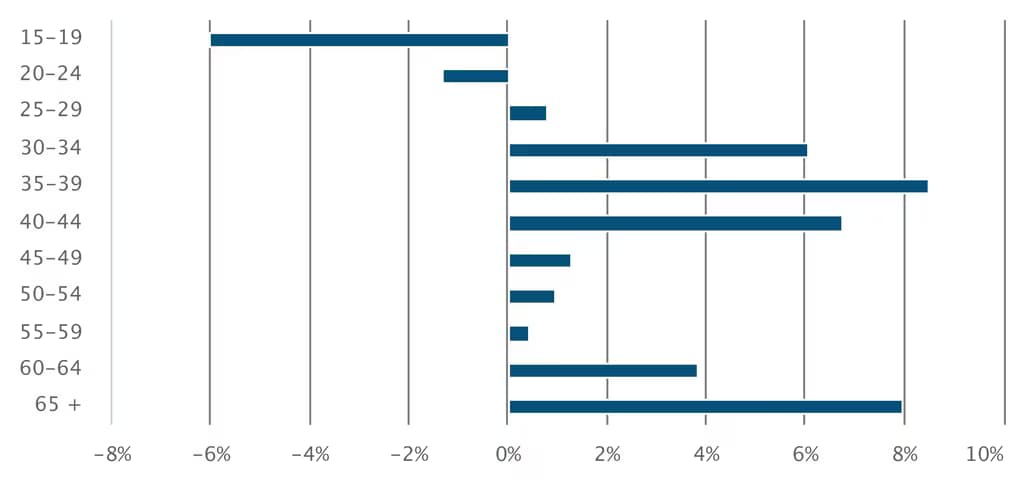
- Filled job declines in the 15-19-year-old age group accelerated to 6.0%pa in October, and filled jobs in the 20-24-year-old age group eased a more moderate 1.3%pa.
- Filled jobs in the over 30 age group rose 4.5%pa, the most rapid growth for this group since the series began in 2019.
- Earnings per filled job rose 12%pa in October, taking annual average growth to 5.8%pa, slightly higher than in the September year.
Migration keeps 30-44-year-old jobs growth high
Annual % change in filled jobs, by age, Oct-23, New Zealand
...and our reaction
- Jobs growth in October was heavily supported by the one-off boost to public administration over the election. Growth continued to slow across a number of key industries, including transport, rental and real-estate, construction, and professional services.
- The election boost to filled jobs will subside in November, and hiring is expected to continue slowing down into 2024 as remaining labour shortages are filled. Uncertain demand conditions are also tempering hiring, with household spending to remain subdued over the next year.
- Elevated earnings growth in October was likely influenced by recent public sector collective agreements for higher pay in nursing, teaching, and defence. We expect the slow-down in hiring, and increasing unemployment (pointing to more spare capacity in the labour market) will continue to reduce wage cost pressures going forward.
- Soft global demand is keeping the primary sector under considerable pressure, with meat and forestry prices easing further amid rising farm and labour costs.
- Record-breaking population growth, particularly in the working-age population due to strong net migration, is keeping jobs growth in the 30-44-year-old age range especially high. As demand for labour slows across New Zealand, we expect migration will begin to come down from a peak, which will cause the outflow of younger workers to pose an increasingly difficult challenge to our already-tight labour market.
Latest updates
Premium

Employment indicators
Further weak employment recovery
Tue 28 Jul 2026
Monthly
0.1% Filled jobs rose in June 2026 (sa)0.6%pa Filled jobs were up from June 2025 1.5%pa South Island filled jobs incre from June 2025
Premium
Employment indicators
Public sector leads job gains
Mon 29 Jun 2026
Monthly
0.3% Filled jobs in May (sa) 0.1% Filled jobs in April (sa)0.7% Filled jobs from May 2025
Employment indicators
Healthcare leads job growth
Thu 28 May 2026
Monthly
0.2% Filled jobs in April (sa)0.5% Filled jobs from April 20255,527 Healthcare jobs over the year to AprilEmployment indicators
Let’s hear it for the South
Tue 28 Apr 2026
Monthly
0.3% Filled jobs in March (sa)0.2% Filled jobs in February (sa)1.5%pa South Island jobs in March