Non-residential building consents
Both public and private consents lose momentum in October
30 Nov 2023

Our take on the latest Non-residential building consents (Thu 30 Nov 2023)
Value of non-res consents
$738m

In October 2023
Annual growth in public consents falls to 0.7%pa
Annual private consent growth eases to 3.9%pa
The key numbers...
- The value of non-residential building consents totalled $738m in October, up 16% from September (seasonally adjusted). Despite a solid monthly result, the annual value of building consents fell to its lowest level since late 2021, after stripping out the effect of rising construction costs.
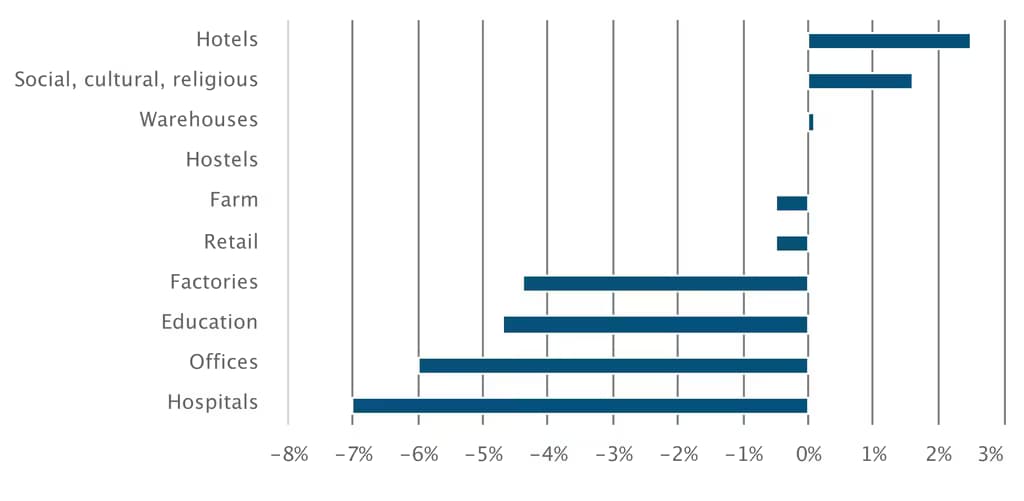
- Hospital and education consents continue to come down from a peak, easing 38%pa and 31%pa respectively over the three months to October. Both retail and factory consents declined on a three-month annual basis for a second consecutive month.
- Hotel consents were up $69m from October 2022, taking year-end growth to 29%pa. The value of hotel consents were boosted by two new hotels in Auckland – an InterContinental in the CBD, and another at the airport.
- Private consents maintained their downward trajectory, easing 10%pa over the three months to October. The largest three-month annual declines were in factories (34%pa) offices (30%pa).
- Some momentum is now coming out of construction in Canterbury and Otago, with consents easing by $23m and $39m respectively from October 2022. Consent values in Auckland were up $118m from October 2022, with strong results across hotel, hospital, and storage consents.
Declines continue across most building types
Contribution to annual % change for three months to October 2023
...and our reaction
- Annual non-residential consents eased further in October, as high interest rates and rising building costs continue to dampen investment. Ongoing declines in office, retail, and factory consents provides further evidence that the trend in private sector activity is beginning to shift, despite a temporary boost from hotel consents.
- Hospital consents have switched from being the primary driver of non-residential growth, to being the largest detractor. Because most of the major consenting was done in late-2022, and these large consents are essentially one-offs, growth is expected to continue easing into 2024. However, the high volume of hospital consents over the last year, with a few more large projects still to come, will keep actual construction activity considerably above pre-pandemic levels over the next few years.
- Public sector work is expected to support overall non-residential activity over the next year, particularly in hospital and social building, but higher construction costs and local government budget constraints will make it difficult to advance new projects. High interest rates, with the potential for a further increase to the OCR, will continue to subdue the private sector. We expect the total value of annual non-residential consents to reach a low of $9.5b in mid-2024.
Latest updates
Premium

Non-residential building consents
Warehouses prevent further non-res falls in June
Mon 3 Aug 2026
Monthly
$701m Value of non-res consents in June 2026
7.4% Total non-res consents from May 2026 (seas adj) 37%pa Warehouse consents from June 2025
Premium
Non-residential building consents
Non-res consents weaker still in May
Thu 2 Jul 2026
Monthly
$789m Value of non-res consents in May 2026
19% Monthly consents from May 202549% Public sector consents from May 2025Non-residential building consents
Non-res consents mostly softer in April
Wed 3 Jun 2026
Monthly
$655m Value of non-res consents in April 2026
15% Monthly consents from April 2025 Office and education consents at lowest monthly levels in 5-6 years
Non-residential building consents
Consents strong in March, but shadow of conflict looms
Fri 1 May 2026
Monthly
$862m Value of non-res consents in March 2026
15% Monthly consents from Mar 2025$119m Hostel consents from Mar 2025