
Our take on the latest Employment indicators (Mon 30 Oct 2023)

Filled jobs up 0.4% in September (seasonally adjusted)
Health care employment expands by 12,100 jobs from September 2022
Public admin jobs grow 7.0%pa, boosted by election
The key numbers...
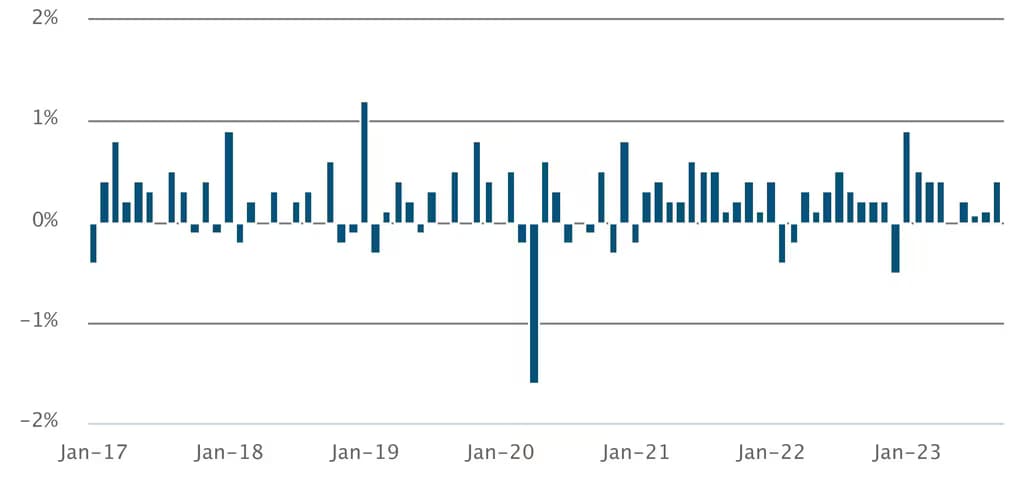
- Filled job numbers rose 0.4% in September from August (seasonally adjusted), driven by a 0.4% increase in service industries and a 0.5% increase in goods-producing industries.
- Total filled jobs growth lifted slightly from 2.9%pa in August to 3.1%pa in September. Although service industries growth accelerated to 3.5%pa, growth remained below its early 2023 peak.
- Public administration and safety jobs growth accelerated to 7.0%pa in September, an expansion of 10,700 jobs from September 2022. Stronger growth in September is consistent with previous patterns of employment in this industry spiking during the month before, and of, the election.
- Transport, postal, and warehousing overtook arts and recreation services as the fastest growing industry in September, with filled jobs rising 8.6%pa.
- Professional services shrank by 1,100 jobs from September 2022, a decline of 0.6%. This industry had been consistently growing over the last three years.
- The outflow of younger workers intensified in September, with declines in filled jobs in the under-24 age group worsening from 1.7%pa in August, to 2.6%pa. However, employment growth across all other age groups accelerated slightly from August.
- Earnings per filled job grew 5.4%pa in September, a slightly stronger result than August, but considerably below the January 2022 peak. Earnings growth remained around two percentage points above pre-pandemic levels, with the labour market still tight.
Boost to monthly jobs growth in September
Filled jobs, monthly % change, seasonally adjusted
...and our reaction
- There were pockets of strength in September, particularly in public administration, as fixed term staff were employed by the Electoral Commission. However, annual jobs growth continued to slow in several key industries, including accommodation and food services, arts and recreation, and education.
- We expect the small spike in employment growth over the election period to be temporary, and that annual employment growth will continue easing over the rest of 2023 and into 2024, as remaining shortages are filled and migrant arrivals come down from a peak.
- The fact that under-30 employment growth is weakening further as over-30 employment growth pushes to new record highs points to a severe polarisation in opportunities across different age groups.
- The outflow of young people and young families, also affirmed by recent population data, is particularly concerning as momentum comes out of migration and the natural increase (number of births relative to deaths) continues to ease.
- It is also worth noting that employment in primary industries fell below 100,000 in September as the agriculture, forestry, and fishing industry shrinks further. Profit margins in this industry are under immense pressure as weak Chinese economic growth undermines commodity prices, yet production costs remain significantly higher than they were pre-pandemic.
Latest updates
Premium

Employment indicators
Further weak employment recovery
Tue 28 Jul 2026
Monthly
0.1% Filled jobs rose in June 2026 (sa)0.6%pa Filled jobs were up from June 2025 1.5%pa South Island filled jobs incre from June 2025
Premium
Employment indicators
Public sector leads job gains
Mon 29 Jun 2026
Monthly
0.3% Filled jobs in May (sa) 0.1% Filled jobs in April (sa)0.7% Filled jobs from May 2025
Employment indicators
Healthcare leads job growth
Thu 28 May 2026
Monthly
0.2% Filled jobs in April (sa)0.5% Filled jobs from April 20255,527 Healthcare jobs over the year to AprilEmployment indicators
Let’s hear it for the South
Tue 28 Apr 2026
Monthly
0.3% Filled jobs in March (sa)0.2% Filled jobs in February (sa)1.5%pa South Island jobs in March