Non-residential building consents
Confidence starting to weigh on non-res consents
2 Oct 2023

Our take on the latest Non-residential building consents (Mon 2 Oct 2023)
Value of non-res consents
$751m

In August 2023
Real value of consents down 29% from Aug 2022
Office consents down 34% over three months to August
The key numbers...
- Non-residential building recorded its lowest monthly consent total since January this year (seasonally adjusted). After stripping out building cost inflation, it was the second weakest result since October 2020.
- We estimate that the annual decline in consents, adjusted for building cost inflation, was 29% from last August. This fall was the largest since April 2020, when the country was stuck in the first COVID-19 lockdown.
- Offices recorded the biggest decline in consents from a year ago, down by $146m. This fall included drops of $114m in Wellington City and $25m in Waitematā.
- Other large annual falls were recorded by factories (-$41m) and hospitals (-$38m).
- Consent totals were sharply lower than a year earlier in Wellington City (-$111m), Christchurch (-$102m), and Palmerston North (-$40m).
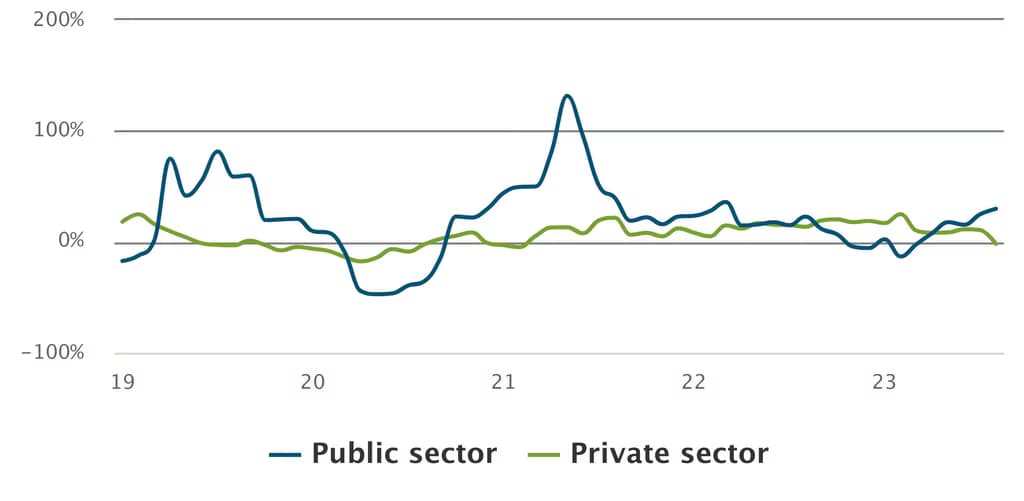
Growth in private sector consents fading
Non-residential consents, six-month annual % changes
...and our reaction
- Although the decline in non-residential consents from a year ago is exaggerated by a single $127m office consent in Wellington that was issued in August 2022, activity remains in line with our expectations of a weaker September quarter figure after June’s buoyant result.
- There are signs in the data that private sector work is losing some momentum, with the consent total over the last six months lower than the same period a year ago for the first time since early 2021. Alongside the decline in office consents, there are also weaker trends coming through for storage and farm buildings.
- These figures align with ebbing confidence in prospects for commercial construction shown in ANZ’s Business Outlook. The latest survey showed commercial construction confidence at -30%, reinforcing the gradual downward trend in confidence that has been present for the last two years.
- Public sector work remains variable on a month-to-month basis. However, as developers respond to high interest rates and weaker economic conditions by scaling back activity during 2024, education and hospital building projects look likely to mitigate the weakness in overall non-residential construction.
Latest updates
Premium

Non-residential building consents
Warehouses prevent further non-res falls in June
Mon 3 Aug 2026
Monthly
$701m Value of non-res consents in June 2026
7.4% Total non-res consents from May 2026 (seas adj) 37%pa Warehouse consents from June 2025
Premium
Non-residential building consents
Non-res consents weaker still in May
Thu 2 Jul 2026
Monthly
$789m Value of non-res consents in May 2026
19% Monthly consents from May 202549% Public sector consents from May 2025Non-residential building consents
Non-res consents mostly softer in April
Wed 3 Jun 2026
Monthly
$655m Value of non-res consents in April 2026
15% Monthly consents from April 2025 Office and education consents at lowest monthly levels in 5-6 years
Non-residential building consents
Consents strong in March, but shadow of conflict looms
Fri 1 May 2026
Monthly
$862m Value of non-res consents in March 2026
15% Monthly consents from Mar 2025$119m Hostel consents from Mar 2025