Residential building consents
Both standalones and townhouses continue to fall sharply
2 Oct 2023

Our take on the latest Residential building consents (Mon 2 Oct 2023)
Annual dwelling consents
42,110

As at August 2023
Total new dwelling consents down 17%pa over year to August
Dwelling consents now easing in all regions but one
The key numbers...
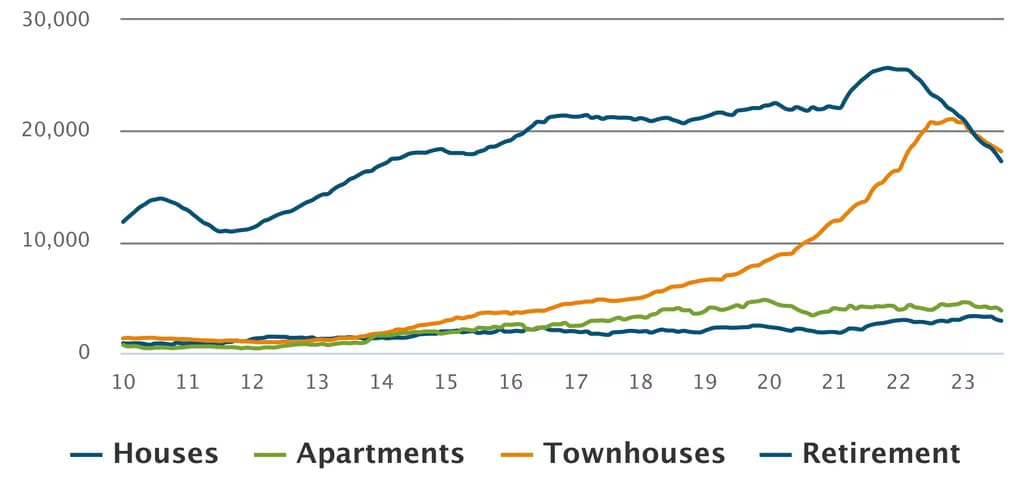
- There were 3,170 new dwelling consents issued in August, a 6.7% decline from July on a seasonally adjusted basis. Total dwellings consents were down 30%pa from August 2022 (the largest decline in over a decade), driven by a 36%pa fall in standalone house consents.
- Townhouse consents fell 12%pa over the year to August, marking the second consecutive month of double-digit annual declines for this building type.
- Retirement consents rose 2.4%pa over the year to August, a markedly softer increase compared to double-digit growth over the previous six months.
- Dwelling consents are now easing on an annual basis across all regions expect Marlborough. Both retirement and townhouse consents are supporting year-end growth in Marlborough, although there have been no new retirement consents in the region since April.
Townhouses falling steeply too
Dwelling consents, annual running totals
...and our reaction
- Total annual dwelling consents are now 17% below their mid-2022 peak as building intentions continue to weaken. High interest rates continue to squeeze developers’ profit margins, making new builds less attractive.
- Despite the current downturn, there were 6,500 more dwellings consented across New Zealand over the past year compared to pre-pandemic (August 2019 year), supported by a higher population and permanently elevated house prices.
- Annual townhouse consent growth weakened in August across most regions. Notably, townhouse consent growth turned negative in Canterbury after several years of consistent growth, with 130 fewer townhouses consented over the last year compared to the August 2022 year. Being the more affordable option, townhouse consents have held up for longer than standalone house consents, but an accelerated decline now in this building type reflects the severity of pressures across the sector.
- Surprisingly strong GDP growth and stubborn domestic inflation are raising the potential for further increases to the official cash rate. However, the emerging rally in house prices could outweigh the effects of rising interest rates and help put a floor under residential activity in 2024.
Latest updates
Premium

Residential building consents
Residential consents fall 3.6% in June
Mon 3 Aug 2026
Monthly
40,581 Annual consents over the June 2026 year
 19% June 2026 consents over the June 2026 year3.6% June 2026 consents from May on a seas. adj. basis
Premium
Residential building consents
Residential consents fall 4.0% in May
Thu 2 Jul 2026
Monthly
 39,737 Annual consents over May 2026 year4.0% May 2026 consents from April on a seas. adj. basis22%pa Townhouse consents over May 2026 year
Residential building consents
Residential consents jump up 11% in April
Wed 3 Jun 2026
Monthly
39,087 Annual consents over April 2026 year11% April 2026 consents from March on a seas. adj. basis19%pa Multi-unit consents over April 2026 yearResidential building consents
Residential consent momentum trends sideways
Fri 1 May 2026
Monthly
37,813 Annual consents over March 2026 year 3,300pm Consents trend sideways on a seas. adj. basis14%pa Townhouse consents over March 2026 year