Employment indicators
Further evidence of stabilising jobs growth in August
28 Sept 2023

Our take on the latest Employment indicators (Thu 28 Sept 2023)



Filled jobs up 0.2% in August (seasonally adjusted)
Health care expands by 11,700 jobs from August 2022
Growth in earnings per filled job decelerates to 5.1%pa
The key numbers...
- Filled jobs rose 0.2% in August from July (seasonally adjusted), maintaining a fairly steady path of monthly jobs growth.
- Total filled jobs growth over the last three months eased to 3.3%pa, down slightly from a recent peak of 3.5% over the three months to May.
- Professional services employment growth eased to 0.1%pa in August, its growth rate since mid-2020.
- The health care industry overtook accommodation and food services as the top contributor to annual jobs growth, expanding by 11,700 jobs from August 2022. Public administration and manufacturing were also key drivers of growth.
- Agriculture, forestry, and fishing remains the only industry where job numbers are declining, shrinking by 2,600 jobs since August 2022.
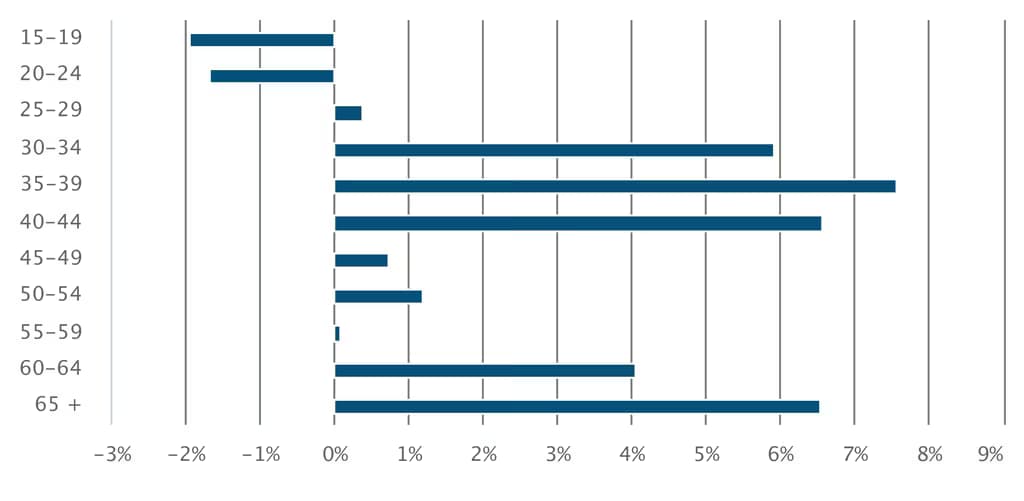
- Filled jobs growth in the 15-19-year-old age group has been slowing since March, and turned negative in August (-1.9%pa) for the first time since early 2021. Job losses in the 20-24-year-old group worsened to 1.7%pa.
- Wage pressures have softened significantly from their February 2022 peak, with growth in earnings per filled job easing to 5.1%pa over the 12 months to August. Earnings per filled job are still growing around two percentage points faster than pre-pandemic (August 2019).
Outflow of younger workers continues
Annual % change in filled jobs, by age, Aug-23
...and our reaction
- The three-month annual growth rate in job numbers eased a touch further in August, affirming our view that hiring is beginning to stabilise across some parts of the economy.
- Annual jobs growth was slower in August (compared to July) across several key industries, including professional services, construction, retail trade, accommodation and food services, and rental/real-estate.
- High migration is continuing to provide for a larger labour supply, with filled jobs growth in the over-30 age group (4.1%pa in August) reaching its fastest rate since the data series began in 2020.
- However, sharp declines in employment among the 15-19 and 20-24-year-old age groups has caused annual growth in the under-30 category to turn negative (-0.9%pa) for the first time in over two years.
- Although this outflow has a less noticeable impact on the labour pool in the current high migration environment, the “brain-drain” is a long-term concern that will become more critical as inward migration flows return to normal levels, and the population ages further.
Latest updates
Premium

Employment indicators
Further weak employment recovery
Tue 28 Jul 2026
Monthly
0.1% Filled jobs rose in June 2026 (sa)0.6%pa Filled jobs were up from June 20251.5%pa South Island filled jobs incre from June 2025Premium
Employment indicators
Public sector leads job gains
Mon 29 Jun 2026
Monthly
0.3% Filled jobs in May (sa) 0.1% Filled jobs in April (sa)0.7% Filled jobs from May 2025
Employment indicators
Healthcare leads job growth
Thu 28 May 2026
Monthly
0.2% Filled jobs in April (sa)0.5% Filled jobs from April 20255,527 Healthcare jobs over the year to AprilEmployment indicators
Let’s hear it for the South
Tue 28 Apr 2026
Monthly
0.3% Filled jobs in March (sa)0.2% Filled jobs in February (sa)1.5%pa South Island jobs in March