
Our take on the latest Retail trade survey (Wed 23 Aug 2023)



Total retail sales volumes down 1.0% from March 2023 quarter (seasonally adjusted)
Sales values at a plateau
Hardware and clothing volumes falling steeply
The key numbers...
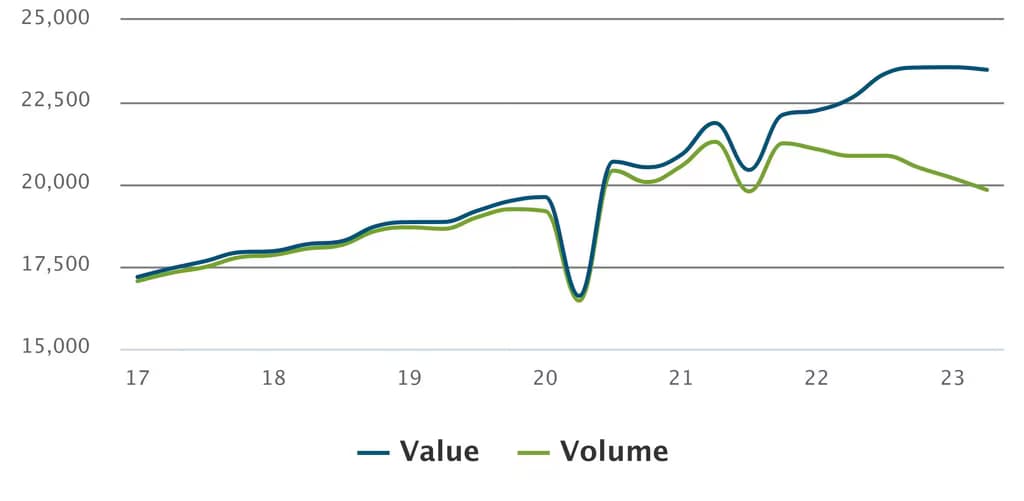
- Total retail sales values eased for a second consecutive quarter, falling 0.2% in the June 2023 quarter from March (seasonally adjusted). After adjusting for the impact of rising prices, total retail sales volumes were down 1.0%.
- Core retail sales volumes, which exclude motor vehicle and fuel retailing, fell 1.8% from the March 2023 quarter. The volume of core retail services is now back down to the lowest levels since the Delta lockdown affects recorded in the September 2021 quarter.
- Volumes in hardware, food and beverage services, clothing, and recreational goods retailing all fell more than 4.0% in June compared to the March quarter (seasonally adjusted). Together, the hardware and food and beverage industries accounted for around two thirds of the total decline in core retail volumes.
- The actual value of food and beverage services spending fell 2.3% in the June quarter on a seasonally adjusted basis, the first negative result since the Delta lockdown. Accommodation services spending values remained relatively flat, rising 0.1% on the same basis.
- Stock totals continued to trend down, easing 1.4% in June on a seasonally adjusted basis. Despite the recent easing, stock totals remain elevated compared to pre-pandemic levels and are sitting 15% above stock values at the start of 2020.
Volumes keep falling and values flatten
Retail sales values, core measure, seasonally adjusted, $b
...and our reaction
- The fall in spending values in the June quarter, even as prices continue to rise, indicates that household spending is starting to feel the effects of both higher prices and less disposable income. One-year fixed mortgage rates have pushed to above 7%pa, with smaller household budgets appearing as money is funnelled off to afford higher mortgage repayments and leaving less money available for other spending.
- Although spending has declined slightly, higher prices, a larger population, a record-high employment rate, and still elevated consumption mean that core retail values over the year to June are still 25% higher than pre-pandemic (June 2019 year) levels. Actual spending levels will remain highly elevated, given that prices are expected to only grow more slowly, rather than actually fall.
- Flat accommodation spending as food and beverage services spending declines suggests that lower spending from locals is offsetting some of the boost from rebounding tourism.
- Lower spending is concentrated on less essential purchases, with spending volumes across hardware and food and beverage services continuing to decline more rapidly than essential categories like supermarkets. Households will be increasingly forced to concentrate their spending on essential goods in the near-term, with domestically-based inflation remaining stubborn and interest rates set to stay higher for longer.
- Although declining, stock levels are still higher than any time before December 2022, even as spending activity falls, meaning that some businesses are facing oversupply and may need to discount more to reduce their stock holdings, and will also limit price increases in some areas. Reducing stock holdings will be important for businesses facing a period of cooler spending activity, but will be difficult to achieve quickly after many built up high levels of stock when pandemic-related supply chain issues were dominant.
Latest updates
Premium

Retail trade survey
Core retail volumes grow slower as consumers adjust to elevated fuel prices
Mon 24 Aug 2026
Quarterly
-0.5% Total retail sales volumes in the June 2026 quarter (seas. adj.) +0.7% Core retail sales volumes in the June 2026 quarter (seas. adj.)+6.5%pa South Island core retail sales in the June 2026 quarter
Premium
Retail trade survey
Anxious consumers pull back on discretionary spending
Fri 22 May 2026
Quarterly
1.0% Core retail sales volumes in the March 2026 quarter (seas. adj.)8 of 13 core industries recorded quarterly rises (seas. adj.)-4.8% Clothing, footwear in the March 2026 quarter (seas. adj.)Retail trade survey
Retail spending continues to strengthen
Mon 23 Feb 2026
Quarterly
1.5% Core retail sales volumes in December (seas. adj.)11 of 13 core industries recorded quarterly rises (seas. adj.)South Island continues to lead the recoveryRetail trade survey
Retail spending recovery gaining traction
Thu 27 Nov 2025
Quarterly
Core retail sales volumes up 1.2% in September (seas. adj.) Seven of 13 core industries saw quarterly rises (seas. adj.)North Island growth starting to follow the South’s lead