
Our take on the latest Residential building consents (Tue 1 Aug 2023)
Annual dwelling consents
44,529


As at June 2023
Total new dwelling consents down 20% from June 2022 quarter
Townshare share of total dwellings lifts to 47% in June 2023 quarter
The key numbers...
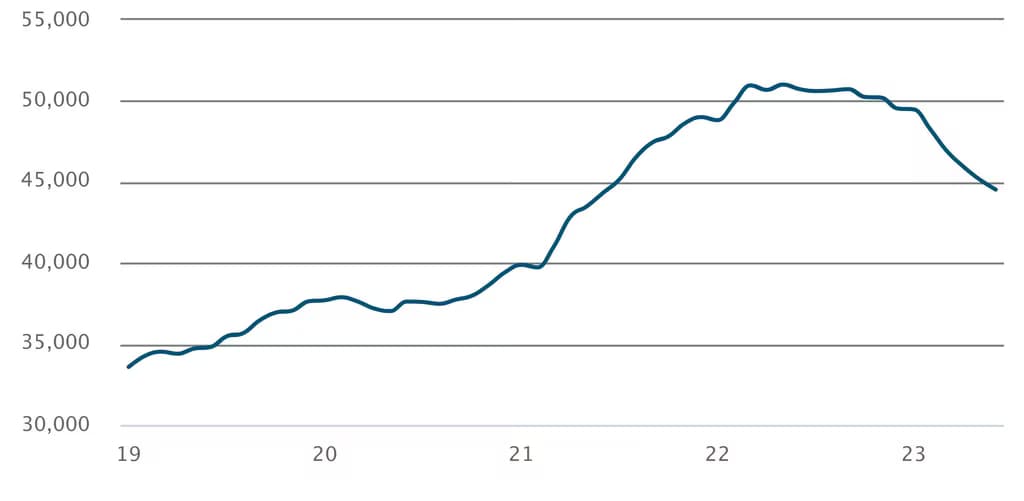
- The decline of dwelling consents paused in June 2023, rising 3.5% from May on a seasonally adjusted basis. However, consents fell 20%pa in the June 2023 quarter, with the lowest level of consenting since the June 2020 quarter. Annual consents for year to June 2023 dropped to 44,259, 12% lower than June 2022 year.
- There was a 6.4% increase in houses and 1.3% increase in non-houses from May, on a seasonally adjusted basis. Within the non-house grouping, townhouses are proving relatively resilient, growing their share to 47% of new dwellings in the June quarter. Townhouses accounted for 62% of dwellings in Auckland, and 36% across the rest of the country.
- Dwelling consents have eased throughout the country over the past year, with the exception of Gisborne, Tasman, Nelson and Marlborough. In all four regions, standalone house consents have eased, with a pickup in townhouses buoyed Gisborne and Tasman, and a pickup in retirement units buoying Nelson and Marlborough.
Heading down, slowly
Dwelling consents, annual running totals
...and our reaction
- New dwelling consents have taken a pause on the way down, with a modest seasonally adjusted rise in June amidst a 20% annual decline. Despite the pause, it’s hard to see consents heading anywhere but down for the rest of the year, with weak houses prices and poor economic conditions more generally. House prices appear to have reached their trough but we don’t expect this to translate to an upside for consents given the constraint of high mortgage interest rates. Strong net migration will boost demand for housing and may put to a stop to further declines in dwelling consents in 2024.
Consenting for public sector owned dwellings has crept up over the past six months, at the same time as private sector activity pulled back in response to market conditions. This means that the public sector accounted for 12% of all new dwellings in the month of June, compared with an average of 4.5% in the year to June 2022. It remains to be seen whether the public sector can build up activity to help maintain industry capacity while construction of privately-owned dwellings is weakening.
Latest updates
Premium

Residential building consents
Residential consents fall 3.6% in June
Mon 3 Aug 2026
Monthly
40,581 Annual consents over the June 2026 year
 19% June 2026 consents over the June 2026 year
 3.6% June 2026 consents from May on a seas. adj. basis
Premium
Residential building consents
Residential consents fall 4.0% in May
Thu 2 Jul 2026
Monthly
39,737 Annual consents over May 2026 year4.0% May 2026 consents from April on a seas. adj. basis22%pa Townhouse consents over May 2026 yearResidential building consents
Residential consents jump up 11% in April
Wed 3 Jun 2026
Monthly
39,087 Annual consents over April 2026 year11% April 2026 consents from March on a seas. adj. basis19%pa Multi-unit consents over April 2026 yearResidential building consents
Residential consent momentum trends sideways
Fri 1 May 2026
Monthly
37,813 Annual consents over March 2026 year 3,300pm Consents trend sideways on a seas. adj. basis14%pa Townhouse consents over March 2026 year