
Our take on the latest Residential building consents (Mon 3 Jul 2023)
Annual dwelling consents
45,159

As at May 2023
Total new dwelling consents down 2.2% from April (seasonally adjusted)
Annual townhouse consents down 3.2%pa in May
The key numbers...
- There were 3,725 new dwelling consents issued in May, a 2.2% decline from the previous month on a seasonally adjusted basis. Total new dwelling consents in May fell 18% compared to May 2022, but the value of consents only declined 7.8%, as higher building costs continue to inflate the true value of consenting activity.
- Around 44% of new dwelling consents issued in May were for standalone houses, with 1,643 consents issued, a 1.6% increase from April on a seasonally adjusted basis. The remaining 56% of new dwelling consents in May were for attached dwellings, with 1,732 townhouse consents, 225 consents for apartments, and 125 consents for retirement units.
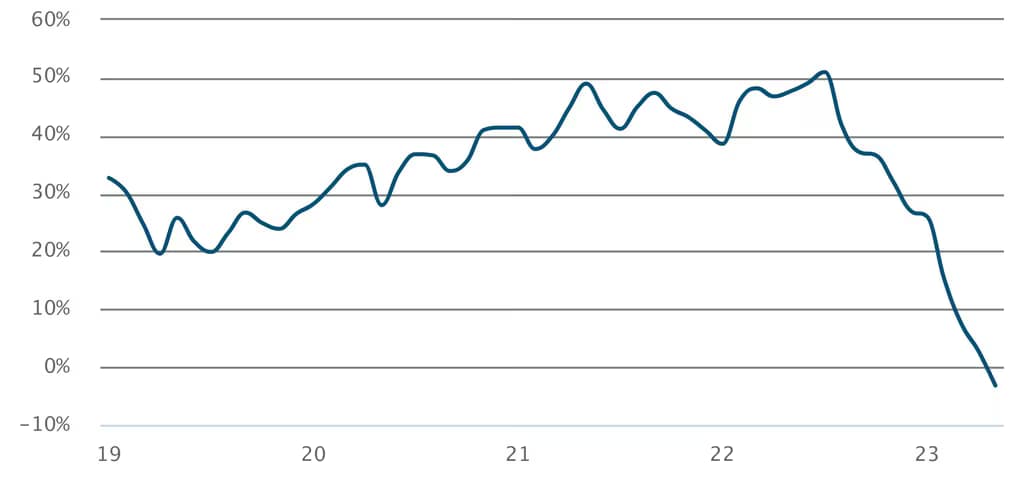
- Annual non-house dwelling consents eased for the first time since November 2011, with consents in the year to May down 0.2%pa. Softer consents for new townhouses are the main driver of this decline, with annual townhouse consents falling 3.2%pa in May.
- New dwelling consents are softening across the country, with consents in the three months to May falling in 12 out of 16 regions compared to the same period last year. Consents for new townhouses are also generally falling nationwide, with consents in the three months to May falling in 10 out of 16 regions when compared to the same period last year.
Annual townhouse consents fall for first time since 2012
Consents for new townhouses, year-end % changes
...and our reaction
- New dwelling consents continued to soften in May, as economic conditions constrain household budgets and squeeze developers’ profit margins. Initially, this softness was primarily driven by declining consents for new standalone houses, but weakness is now filtering through into consents for new attached dwellings.
- Signs are emerging that inflationary pressures are easing and interest rates are near their peak. Additionally, New Zealand has experienced higher net migration in the last six months, which should buoy demand for new housing in the medium term. These factors combined could see the downward momentum in new dwelling consents start to dissipate in the first half of 2024, particularly in regions with that typically attract higher shares of migrant arrivals.
- Despite new dwelling consents continuing to soften, there were still over 45,000 consents issued in the last year, which suggests there remains a sizable pipeline of future work in the residential construction sector.
Latest updates
Premium

Residential building consents
Residential consents fall 3.6% in June
Mon 3 Aug 2026
Monthly
40,581 Annual consents over the June 2026 year
 19% June 2026 consents over the June 2026 year
 3.6% June 2026 consents from May on a seas. adj. basis
Premium
Residential building consents
Residential consents fall 4.0% in May
Thu 2 Jul 2026
Monthly
 39,737 Annual consents over May 2026 year4.0% May 2026 consents from April on a seas. adj. basis22%pa Townhouse consents over May 2026 year
Residential building consents
Residential consents jump up 11% in April
Wed 3 Jun 2026
Monthly
39,087 Annual consents over April 2026 year11% April 2026 consents from March on a seas. adj. basis19%pa Multi-unit consents over April 2026 yearResidential building consents
Residential consent momentum trends sideways
Fri 1 May 2026
Monthly
37,813 Annual consents over March 2026 year 3,300pm Consents trend sideways on a seas. adj. basis14%pa Townhouse consents over March 2026 year