
Our take on the latest Real estate statistics (Thu 15 Jun 2023)


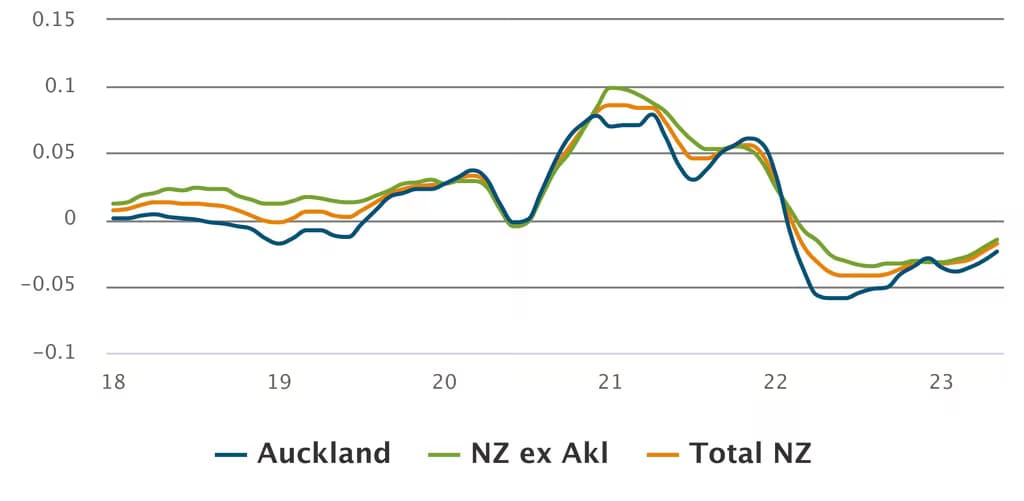
Auckland house prices stable from April (seasonally adjusted)
Sales volumes down just 0.4%pa in May
Median days to sell down 0.3% in May (seasonally adjusted)
The key numbers...
- National house prices fell a further 0.2% in May, with prices still 17% below their November 2021 peak. Auckland prices remained steady from April, arresting six-month streak of declines. All figures are seasonally adjusted.
- On an annual basis, prices in the North Island are continuing to fall faster than in the South Island. Apart from the West Coast and Otago, where prices fell 17% and 11%pa respectively from May 2022, all regions in the South Island recorded declines of less than 10%pa. Conversely, prices in seven out of nine North Island regions dropped more than 10%pa.
- Although sales remain 46% below their December 2020 peak, the pace of house sale declines is easing. National house sales declined 0.4%pa from May 2022, the smallest annual decline since mid-2021.
- The median period to sell a house was 49 days in May, down 0.3% from April on a seasonally adjusted basis.
Pace of house price declines continuing to ease
REINZ House Price Index, three-month % changes (sa)
...and our reaction
- National house prices across New Zealand are continuing to fall, but the slowing rate of decline suggests the market could be near the bottom.
- The Reserve Bank’s announcement that further interest rate hikes are on hold means we no longer expect one-year fixed mortgage rates to surpass 7.0%. The Bank has also recently confirmed that loan-to-value restrictions (LVR) will ease from June 2023, raising the cap on loan values and therefore increasing the amount of lending banks can offer. These changes have added considerable upside risk to our outlook for house prices.
- Annual net migration remains high (reaching 72,300 in April), which, all else being equal, should boost demand for housing, softening falling house prices and lifting sales activity. However, softening arrival numbers in April add some downside risk to the expected impact of migrant demand on the housing market.
- Retail spending data shows a slow-down in discretionary item purchases, suggesting households are still being squeezed by high inflation and higher mortgage rates. Regardless, an improved lending environment, on the back of lower-than-expected peak interest rates and looser LVR settings should put a floor under house prices.
Latest updates
Premium

Real estate statistics
House sales and prices still falling
Thu 13 Aug 2026
Monthly
 10%pa House sales in July 20260.4%pa House prices from a year earlier
 9.3%pa Stock of homes for sale in July 2026
Premium
Real estate statistics
Conflict continues to drag on housing market in June
Wed 15 Jul 2026
Monthly
8.8% House sales between Feb and Jun 2026 (seas adj)0.8% House prices since February (seas adj)4.8% Stock of homes for sale since February (seas adj)Real estate statistics
House buyers dry up ahead of interest rate rises
Mon 15 Jun 2026
Monthly
13%pa House sales in May 20260.6%pa House prices from May 2025 Stock of homes for sale at an 11-year high
Real estate statistics
House prices and sales fall
Thu 14 May 2026
Monthly
7.9%pa House sales in Apr 20260.5% House prices from Mar 2026 (sa) 1.2% Stock of homes for sale since Feb 2026 (sa)