Car registrations
Clean Car Discount changes to slow non-plug-in hybrid registrations
1 Jun 2023

Our take on the latest Car registrations (Thu 1 Jun 2023)



First-time car registrations up 2.7% from April (seasonally adjusted)
New car registrations down 9.4% compared to May 2022
Hybrid and electric car registrations up 55%pa in the year to May
The key numbers...
- There were 19,157 first-time car registrations in May, a 2.7% increase from April on a seasonally adjusted basis. The new and small segments of the market rebounded from sharp declines in April, with registrations of new cars up 4.1% and small cars up 6.6% (both figures seasonally adjusted).
- Despite picking up from April, registrations of new cars were still 9.4% lower than in May 2022, with only 9,568 new cars registered last month. Registrations of large new cars primarily drove the decline, down 15%pa, but small new car registrations also fell 1.8%pa.
- There were 845 new rental cars registered in May, a 43% decline from May 2022, but still 140% more than the average May between 2017-2019.
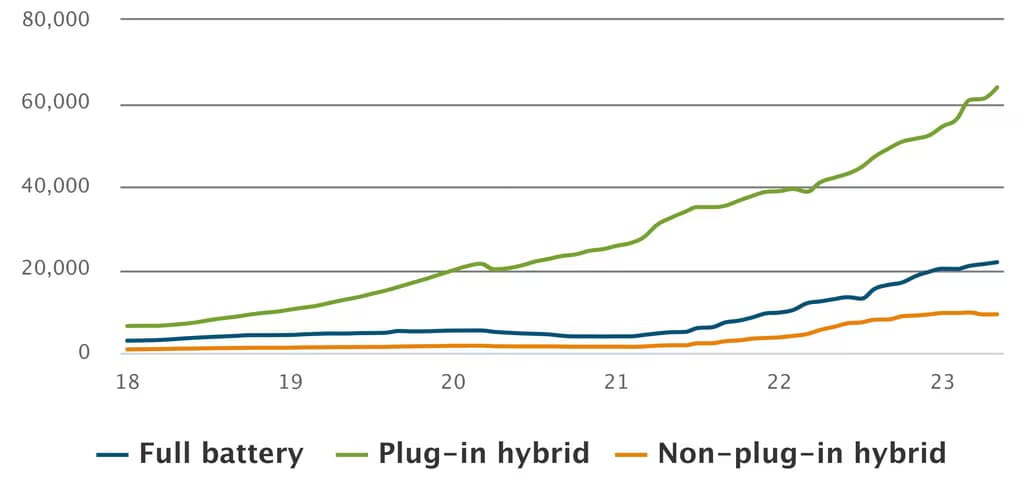
- In the year to May, nearly 95,000 hybrid and electric vehicles were registered, a 55% increase from the May 2022 year. Non-plug-in hybrid cars made up 67% of these registrations, with registrations of full battery electric and plug-in hybrid cars comprising the remaining 23% and 10% respectively.
Non-plug-in hybrids leave FBEVs and PHEVs behind
Annual first-time car registrations
...and our reaction
- Car registrations increased in May, with registrations at least edging up across the new, used, small, and large segments of the market. However, registrations remain softer than during 2021 and 2022, with annual car registrations down 6.5% from May 2021 and 14% from May 2022.
- Inflation was lower than expected in the March 2023 quarter, slowing to 6.7%pa from 7.2% the previous quarter. The Reserve Bank has since indicated that the official cash rate is likely to peak at its current level of 5.50%. Lower inflation and lower interest rates than previously expected paint a slightly rosier picture for future car registrations. Stronger population growth due to a surge in net migration should also support a higher level of car registrations over the medium term.
- Over the last year, non-plug-in hybrid cars have comprised the lion’s share of hybrid and electric car registrations. The strength of non-plug-in hybrids is, in part, likely to be due to a lower purchase price, but also greater versatility and therefore applicability to a wider audience.
- The recently announced changes to the Clean Car Discount will reduce the selection of non-plug-in hybrids that attract a rebate under the scheme, worsening their affordability relative to other cars. The optimistic view might see would-be purchasers instead opting for plug-in hybrid or full battery electric cars, but for many purchasers, their preferences could be hard to shift given the limited applicability of cars that must be charged.
Latest updates
Premium

Car registrations
Strong car registrations despite Iran War
Thu 2 Jul 2026
Quarterly
+19%pa New car registrations in June 2026 quarter+165%pa EV registrations in June 2026 quarter Fuel prices off highs, still 19% higher than pre-conflict
Premium
Car registrations
EV car registrations surge following fuel price spike
Thu 2 Apr 2026
Quarterly
4x higher Full battery EV registrations than in March 2025 Fuel prices rise 30%+ in March 2026Car registrations trending lower before the war
Car registrations
Total car registrations slowly lifting from low
Mon 12 Jan 2026
Quarterly
183,099 Total car registrations in the year to December 2025, down 1.1%pa
Quarterly new car registrations up 6.7%paQuarterly used car registrations down 4.1%paCar registrations
New car registrations lift the annual total from a low
Wed 1 Oct 2025
Quarterly
182,258 Total car registrations in the year to September, up 5.7%pa
New car registrations up 20%pa from September 2024Used car registrations down 7.3%pa from September 2024