
Our take on the latest Retail trade survey (Wed 24 May 2023)



Total retail sales volumes down 0.3% from December 2022 (seasonally adjusted)
Value of core sales still up 6.5% from a year ago
Electrical and hardware volumes fall sharply
The key numbers...
- The value of total retail sales fell 0.3% from the December 2022 quarter on a seasonally adjusted basis. After stripping out the effects of rising prices, this result equated to a 1.4% decline in sales volumes from December.
- Core sales volumes (which exclude motor vehicle and fuel retailing) fell 1.1% from the December quarter. The decline was driven primarily by falling volumes of electronic goods retailing (down 12.2%) and hardware and building supplies sales (6.3%). Food and beverage services increased 1.3% (all figures seasonally adjusted).
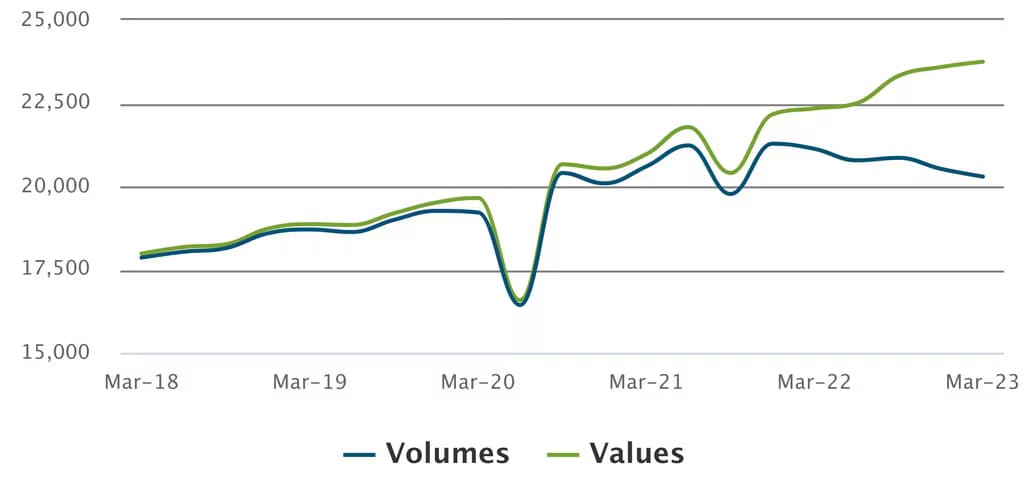
- Core sales volumes (which exclude motor vehicle and fuel retailing) fell 4.0%pa from the March 2022 quarter. The decline was driven primarily by falling volumes of electronic goods retailing (down 29%pa) and hardware and building supplies sales (13%).
- The return of tourism is supporting spending volumes for accommodation and food and beverage services, which increased 19%pa and 14%pa from the March 2022 quarter respectively. The value of core retail sales excluding these categories was up a more modest 1.3% from March 2022, equating to a 7.4% fall in volume terms.
- The annual decline in supermarket sales volumes accelerated to 3.8%pa in the March 2023 quarter, and growth in fuel retailing volumes eased to 3.1%pa.
- Stock totals plateaued in the March 2023 quarter, falling 0.3% from the December 2022 quarter on a seasonally adjusted basis. However, stock totals remain elevated almost 20% above pre-pandemic levels.
Spending more and getting less
Core industries retailing sales, $b (seas. adj.)
...and our reaction
- Spending volumes continued to decline in the March 2023 quarter, but total growth in quarterly sales values for the core retail industries remained positive. We would have expected growth in values to take a sharper hit this quarter, given that one-year fixed mortgage rates have pushed up more than two percentage points from this time last year. In fact, annual growth in the value of core retail spending accelerated from 5.9%pa in the December quarter to 6.5%pa in March.
- Price inflation is extremely elevated across a broad variety of retailing categories. Most notably, supermarket price inflation reached a record high of 11%pa, and department store inflation lifted almost a full percentage point to 3.7%pa.
- Although real consumption is softening as inflation erodes people’s purchasing power, more sustained growth in retail values suggests that households’ nominal spending is surprisingly upbeat, and could indicate to the Reserve Bank that the dampening effect of higher mortgage rates has been muted so far.
- The declines in electronic and hardware sales volumes, in contrast with a gentler decline supermarket volumes, point to households shifting their spending away from more discretionary items. On a seasonally adjusted basis, there were also significant declines from the December quarter in liquor retailing (12.5%) and specialised food retailing (9.1%). These store-types make up a relatively small proportion of overall volumes, but nonetheless indicate there is little room in household budgets for superfluous spending.
- Fuel spending volume growth is likely to continue trending down in the second half of this year given the resumption of the full Fuel Excise Duty and Road User Charges in July. Higher fuel prices will also reduce the amount of available money households have to spend on other goods and services.
- A plateau in stock totals indicate that businesses are likely to be preparing for a much cooler spending environment, and with supply chain disruptions less critical than during the pandemic, they therefore have less need for a large amount of product on hand.
Latest updates
Premium

Retail trade survey
Core retail volumes grow slower as consumers adjust to elevated fuel prices
Mon 24 Aug 2026
Quarterly
-0.5% Total retail sales volumes in the June 2026 quarter (seas. adj.) +0.7% Core retail sales volumes in the June 2026 quarter (seas. adj.)+6.5%pa South Island core retail sales in the June 2026 quarter
Premium
Retail trade survey
Anxious consumers pull back on discretionary spending
Fri 22 May 2026
Quarterly
1.0% Core retail sales volumes in the March 2026 quarter (seas. adj.)8 of 13 core industries recorded quarterly rises (seas. adj.)-4.8% Clothing, footwear in the March 2026 quarter (seas. adj.)Retail trade survey
Retail spending continues to strengthen
Mon 23 Feb 2026
Quarterly
1.5% Core retail sales volumes in December (seas. adj.)11 of 13 core industries recorded quarterly rises (seas. adj.)South Island continues to lead the recoveryRetail trade survey
Retail spending recovery gaining traction
Thu 27 Nov 2025
Quarterly
Core retail sales volumes up 1.2% in September (seas. adj.)Seven of 13 core industries saw quarterly rises (seas. adj.)North Island growth starting to follow the South’s lead