Non-residential building consents
Hospital and cultural buildings driving consents
30 May 2023

Our take on the latest Non-residential building consents (Tue 30 May 2023)
Value of non-res consents
$663m


In April 2023
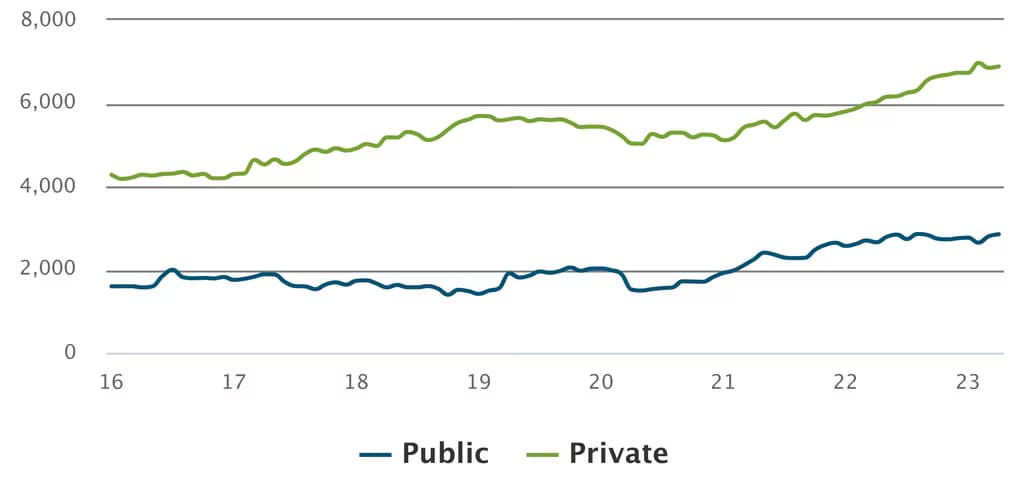
Public consents up 13%pa in three months to April
Annual private consents remain at $6.9b
The key numbers...
- The value of total non-residential building consents totalled $663m in April 2023, down 11%% from March (seasonally adjusted). However, March was the second highest month for non-residential consents on record, and seasonally adjusted consents in April were sitting 2.8% higher than the average value over the second half of 2022.
- Private consents continue to grow at a more restrained pace, with a 9.5%pa rise over the three months to April 2023 compared to double-digit growth over much of 2022. Public consents have strengthened again recently, with 13%pa growth over the same period after a few months of weaker results.
- Office consents totalled $160m, accounting for almost a quarter of total consent values over the month. There was also $144m of hospital consents (22% of total), $83m of education consents (13%), and $75 of warehouse consents (11%).
- Social, cultural, and religious consents were up 122%pa over the three months to April, and hospital consents were up 53%pa. Hotel, factory, and education consents all recorded relatively strong declines of 34%pa, 29%pa, and 25%pa respectively – a sustained trend for these groups for now.
- Consents over the year to April were up $506m in the Canterbury Region, boosted by an additional $273m in social, cultural, and religious consents (the majority of which is for the new Christchurch stadium, Te Kaha), $121m in warehouse consents, and $100m in hospital consents. There was also a $329m increase in annual consent values in Waikato, and a $254 increase in the Auckland Region.
Private consents at a pleateau
Annual running total, $m
...and our reaction
- Private sector funded consents are starting to show signs of a more muted level of activity going forward, as interest rate rises limit future investment decisions. However, this shift in pace for private sector activity comes after a strong level of activity in previous years.
- Public sector investments have regained a bit more momentum recently, consistent with the funding investments that the government has signalled. The 2023 Budget saw further education investment announced on top of previous commitments for continued health infrastructure investments, although the sector remains busy with a number of these larger projects underway.
- Stronger recent activity in social, cultural, and religious reinforces our higher pathway for this building type in our April 2023 forecasts, with more investments in the near term despite funding and near-term capacity constraints.
Latest updates
Premium

Non-residential building consents
Warehouses prevent further non-res falls in June
Mon 3 Aug 2026
Monthly
$701m Value of non-res consents in June 2026
 7.4% Total non-res consents from May 2026 (seas adj)37%pa Warehouse consents from June 2025
Premium
Non-residential building consents
Non-res consents weaker still in May
Thu 2 Jul 2026
Monthly
$789m Value of non-res consents in May 2026
19% Monthly consents from May 202549% Public sector consents from May 2025Non-residential building consents
Non-res consents mostly softer in April
Wed 3 Jun 2026
Monthly
$655m Value of non-res consents in April 2026
15% Monthly consents from April 2025 Office and education consents at lowest monthly levels in 5-6 years
Non-residential building consents
Consents strong in March, but shadow of conflict looms
Fri 1 May 2026
Monthly
$862m Value of non-res consents in March 2026
15% Monthly consents from Mar 2025$119m Hostel consents from Mar 2025