
Our take on the latest Residential building consents (Tue 30 May 2023)
Annual dwelling consents
45,962


As at April 2023
Total new dwelling consents down 2.6% from March (seasonally adjusted)
New house consents down 23%pa over the year to April
The key numbers...
- There were 2,757 new dwelling consents in April, a 2.6% decline from March after accounting for seasonal effects. Consents for new standalone houses fell 2.0% in April on a seasonally adjusted basis.
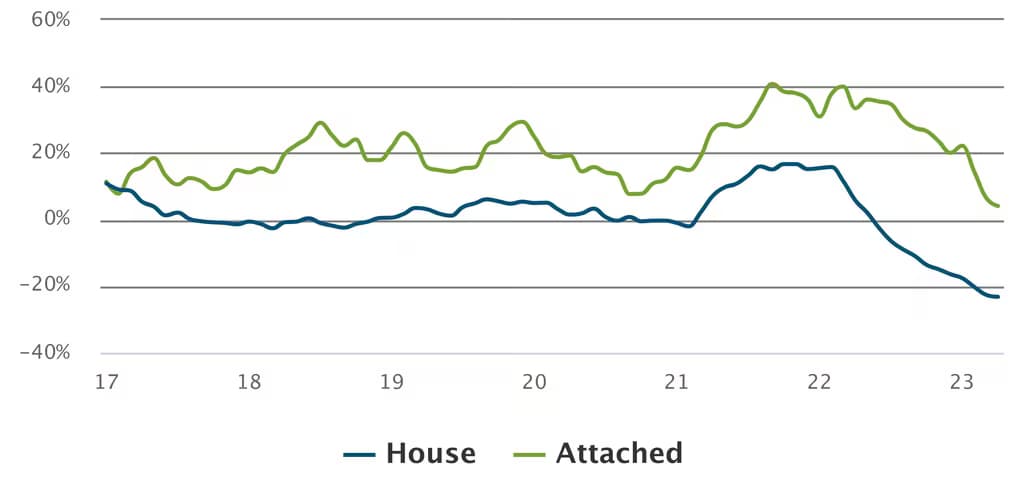
- The fall in new dwelling consents in April drove a decline in the annual consent total, which fell to 45,962, a 9.3% decline from the April 2022 year. Consents for new standalone houses fell at a much faster rate than attached dwelling consents, with new house consents down 23%pa in the April 2023 year, compared to a 4.1%pa increase in attached dwelling consents.
- The largest positive contributors to attached dwelling consents over the year to April were Auckland, Northland, and Canterbury. Consents for new attached dwellings in Northland increased nearly 81% in the 12 months ended April, compared to the previous year. Surprisingly, given its higher urban density and high property values, attached dwelling consents in Wellington fell 3.7%pa over the April year, making Wellington the second-largest detractor from attached dwelling consents growth.
Dwelling consents falling further from pandemic levels
New dwelling consents, year-end % changes
...and our reaction
- After taking a pause in March, new dwelling consents declined in April, taking annual consents 9.9% below the recent May 2022 peak of 51,000. Attached dwelling consents continued to decline at a slower pace than consents for standalone houses, but nevertheless softened substantially over the last year.
- Property prices could be close to bottoming out, and mortgage rates are close to their peak, but housing affordability remains poor. These affordability issues suggest that attached dwelling consents will continue to show strength compared to standalone house consents, given their relatively smaller size and higher density. However, despite showing strength relative to standalone consents, new dwelling consents are undoubtedly softening across the board, including for attached dwellings.
- The pipeline for residential construction activity will likely soften further over the rest of 2023 and 2024, as interest rates (though no longer rising) remain high, and there is limited upside to property values after the substantial pricing correction over the last 18 months, maintaining the squeeze on developers’ margins.
- The strong pipeline of new homes already consented will maintain a solid base of residential construction activity, but new dwelling consents are unlikely to increase over the next 2-3 years. Higher net migration poses an upside risk to this view, but we expect that high interest rates and the relatively higher cost to build a new home (given recent building cost inflation), compared to buying an existing home, will remain major limiting factors on the number of new dwelling consents.
Latest updates
Premium

Residential building consents
Residential consents fall 3.6% in June
Mon 3 Aug 2026
Monthly
40,581 Annual consents over the June 2026 year
 19% June 2026 consents over the June 2026 year3.6% June 2026 consents from May on a seas. adj. basis
Premium
Residential building consents
Residential consents fall 4.0% in May
Thu 2 Jul 2026
Monthly
 39,737 Annual consents over May 2026 year4.0% May 2026 consents from April on a seas. adj. basis22%pa Townhouse consents over May 2026 year
Residential building consents
Residential consents jump up 11% in April
Wed 3 Jun 2026
Monthly
39,087 Annual consents over April 2026 year11% April 2026 consents from March on a seas. adj. basis19%pa Multi-unit consents over April 2026 yearResidential building consents
Residential consent momentum trends sideways
Fri 1 May 2026
Monthly
37,813 Annual consents over March 2026 year 3,300pm Consents trend sideways on a seas. adj. basis14%pa Townhouse consents over March 2026 year