
Our take on the latest Residential building consents (Thu 4 May 2023)
Annual dwelling consents
46,294
As of March 2023
Total new dwelling consents up 7% from February (seasonally adjusted)
New dwelling consents down 7.9% over year to March 2023
The key numbers...
- There were 3,970 new dwelling consents issued in March 2023, up 7.0% from February 2023 on a seasonally adjusted basis.
- Consents have been softening in recent months, and fell more sharply in February, before a bounce back in March. Cyclone Gabrielle doesn’t appear to have had much effect on consents so far, with Northland, Auckland and Hawke’s Bay track close to the national trend. Gisborne is a different story however, jumping to 32 consents in March 2023, the district’s highest month since 2011.
- Standalone house consents were more or less steady across February and March, on a seasonally adjusted basis. However, consents for non-house dwellings grew 12% in March, after a sharp fall in February.
- Growth in both standalone house and non-house consents has been slowing down over the past year, with standalone house consents being the weakest. Standalone house consents fell 23% over the year to March 2023, and non-house consents slowed to 6.6%. Standalone houses accounted for 50% of dwelling consents in the year to March 2022, falling to 42% in the year to March 2023. Apartments, retirement units and townhouses have all been relatively resilient to the overall slowdown thus far. Retirement village units have been strongest, up 14.2% in the year to March 2023.
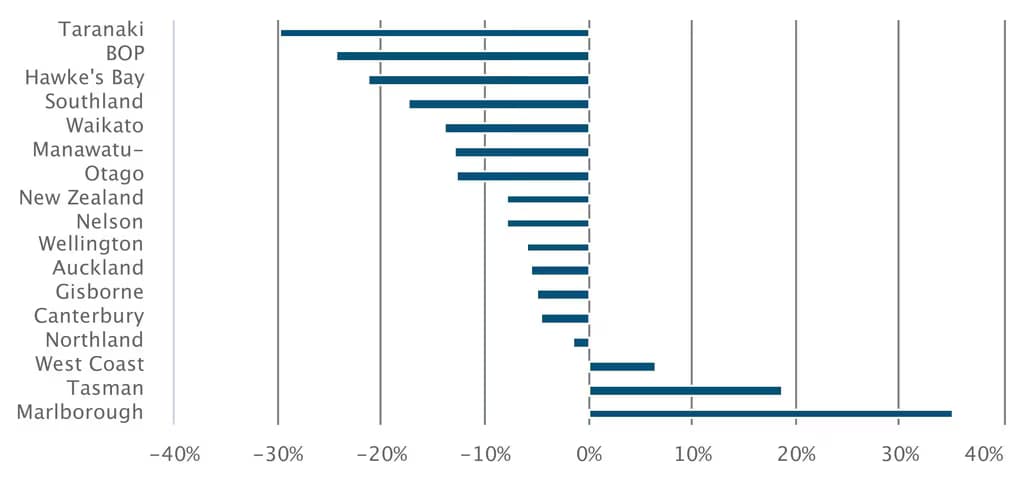
- Dwelling consents have been strongest in Marlborough and Tasman regions, up 35% and 19% respectively over the year to March 2023. West Coast’s consents are up 7% on an annual basis, but March 2023 quarter consents are 40% lower than March 2022. Consents have fallen most sharply in Bay of Plenty, Hawke’s Bay and Taranaki, down 24%, 21% and 30% respectively
Strongest consents in Marlborough and Tasman
% change in new dwelling consents, Mar-23 year
...and our reaction
- New dwelling consents picked up in March, after three months of decline on a seasonally adjusted basis. However, this is likely to be a mere blip as consents correct from a peak of over 50,000 in 2022 to our forecast of 36,600 in the year to March 2024.
- Economic conditions remain very challenging for residential construction, with high interest rates, ever-increasing construction costs, falling house prices and lower household confidence as the economy enters recession. However, net migration remains a wildcard, with a sharp rise in net migration over the past six months potentially cushioning the fall for residential construction.
- Attached dwelling consents are holding up better than standalone house consents, potentially buoyed by affordability advantages. This should place this segment in better stead through the recession, although we still expect this segment to soften in the coming year.
- Cyclone Gabrielle recovery activities should start to come through in consents in coming months. However, the effect is likely to be small, as many repair activities will not require consent and rebuilding is likely to be modest in the national context. Just under 800 properties have been red-stickered, indicating that they are unsafe to enter, across Auckland, Northland, Gisborne and the Hawke’s Bay.
Latest updates
Premium

Residential building consents
Residential consents fall 3.6% in June
Mon 3 Aug 2026
Monthly
40,581 Annual consents over the June 2026 year
 19% June 2026 consents over the June 2026 year
 3.6% June 2026 consents from May on a seas. adj. basis
Premium
Residential building consents
Residential consents fall 4.0% in May
Thu 2 Jul 2026
Monthly
 39,737 Annual consents over May 2026 year4.0% May 2026 consents from April on a seas. adj. basis22%pa Townhouse consents over May 2026 year
Residential building consents
Residential consents jump up 11% in April
Wed 3 Jun 2026
Monthly
39,087 Annual consents over April 2026 year11% April 2026 consents from March on a seas. adj. basis19%pa Multi-unit consents over April 2026 yearResidential building consents
Residential consent momentum trends sideways
Fri 1 May 2026
Monthly
37,813 Annual consents over March 2026 year 3,300pm Consents trend sideways on a seas. adj. basis14%pa Townhouse consents over March 2026 year