Non-residential building consents
Weak start to 2023 for non-residential consents
1 Mar 2023

Our take on the latest Non-residential building consents (Wed 1 Mar 2023)
Value of non-res consents
$475m


In January 2023
Consents down 25% from December (seasonally adjusted)
Several regions contribute to 88%pa lift in factory consents
The key numbers...
- Non-residential building consents in January slumped 25% from December to record their weakest result in over a year (seasonally adjusted).
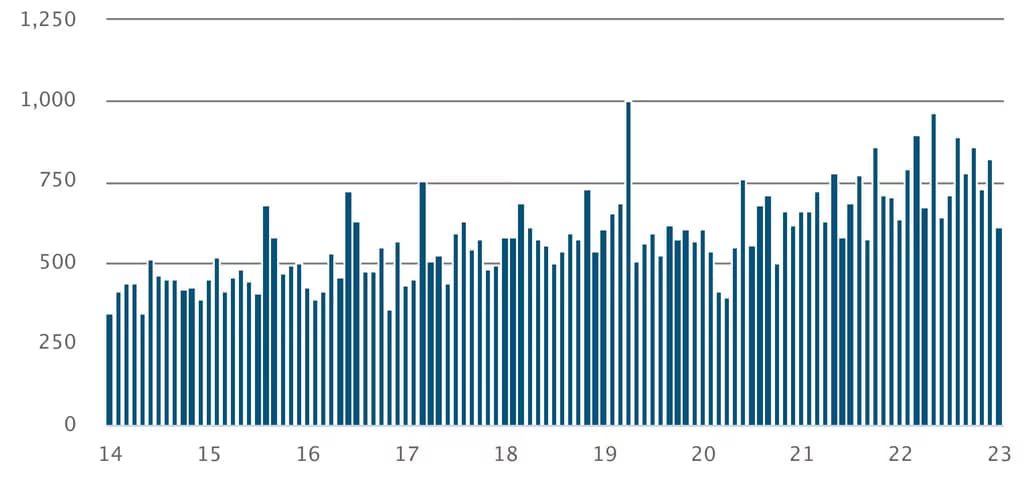
- The upward trend in consents has tapered off over the last four months as both public and private sector growth has softened. The total value of consents in January was up just 2.3% from January 2022. The latest building cost data from Stats NZ shows non-residential building costs rising at 10%pa in the December quarter, implying the volume of activity is starting to slide.
- Factory consents were one of the strongest areas of activity in January, with $133m of consents well up from the $71m recorded in January 2022. There was a $45m consent as part of Fisher & Paykel Healthcare’s new development in East Tāmaki. New Plymouth, Marlborough, Waipā, and Clutha all recorded increases in factory consents of between $13m and $20m.
- Offsetting this increase were declines in hostel consents (including a $22m decline in Waitematā), social consents (down $16m in Buller and $15m in Gisborne), and hospital consents (down $28m in Henderson-Massey).
Monthly value of non-residential consents
Seasonally adjusted, $m
...and our reaction
- The outlook for non-residential construction is weakening due to rising interest rates and an expected downturn in the economy during 2023. A levelling off in public sector work is now being joined by a slowdown in private sector growth, as 6.2%pa average growth in private sector consents over the three months to January was the weakest result since late 2021.
- Commercial construction confidence from ANZ’s Business Outlook has deteriorated in line with broader market conditions. On average over the last three months, a net 23% of respondents expect activity to weaken in the coming year. Apart from the 2020 lockdown, this result is the weakest for any three-month period since 2009.
- Although consents are now softening, stronger growth in consents last year means there is a considerable pipeline of non-residential construction work to take place during 2023/24.
- We do not expect January’s Auckland floods or Cyclone Gabrielle in February to have as large an effect on future work requirements as in the residential and infrastructure subsectors. However, we will continue to monitor new information as we work to estimate the repair and rebuilding work faced by the construction industry following these natural disasters.
Latest updates
Premium

Non-residential building consents
Warehouses prevent further non-res falls in June
Mon 3 Aug 2026
Monthly
$701m Value of non-res consents in June 2026
7.4% Total non-res consents from May 2026 (seas adj)37%pa Warehouse consents from June 2025Premium
Non-residential building consents
Non-res consents weaker still in May
Thu 2 Jul 2026
Monthly
$789m Value of non-res consents in May 2026
19% Monthly consents from May 202549% Public sector consents from May 2025Non-residential building consents
Non-res consents mostly softer in April
Wed 3 Jun 2026
Monthly
$655m Value of non-res consents in April 2026
15% Monthly consents from April 2025 Office and education consents at lowest monthly levels in 5-6 years
Non-residential building consents
Consents strong in March, but shadow of conflict looms
Fri 1 May 2026
Monthly
$862m Value of non-res consents in March 2026
15% Monthly consents from Mar 2025$119m Hostel consents from Mar 2025