
Our take on the latest Employment indicators (Wed 29 Mar 2023)


Filled jobs up 0.4% in February (seasonally adjusted)
Employment growth limited in Hawke's Bay and Gisborne
Solid employment growth across a range of services sectors
The key numbers...
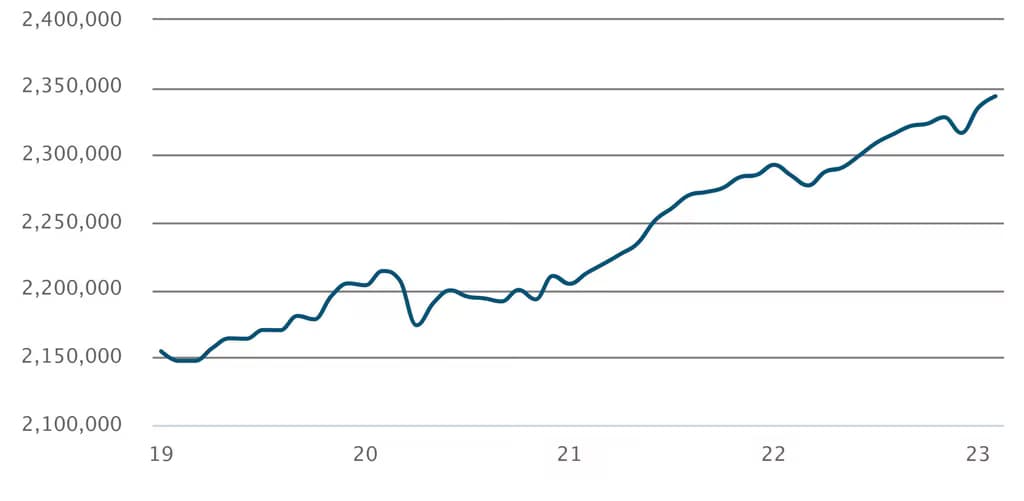
- Filled job numbers rose again in February, with a 0.4% boost from the prior month (seasonally adjusted), a strong follow up to the 0.8% increase in January after a fall at the end of 2022.
- Employment in service industries is leading the jobs charge, with a 3.2% annual increase in filled jobs. The gains are across the board in services, with notable increases in tourism-related industries such as accommodation and food services (8.5%pa), arts and recreation services (6.6%), and transport (6.2%).
- Filled jobs growth remains substantial in other areas too, with a 2.9%pa increase in professional services filled jobs (building on a 9.0% increase a year ago). There was also a 4.2%pa increase in administrative and support services jobs, on top of the 6.2%pa increase for this industry a year ago.
- At a regional level, filled jobs figures show some slowdown in jobs growth in areas affected by Cyclone Gabrielle. Employment in Gisborne in February 2023 was 1.8% lower than a year ago (filled jobs in the region were down 0.1%pa in January), and employment growth in Hawke’s Bay slowed back from 1.2%pa in January 2023 to 0.7%pa in February.
- Earnings per filled job continue to grow at a fast pace, with a 6.7%pa increase in annual average earnings per filled job – in line with recent figures.
Filled jobs just keep on rising
Monthly filled jobs, seasonally adjusted
...and our reaction
- Employment levels continue to rise, with no signs yet of any sustained weaking in job numbers. Although the labour market is always the last part of the economy to turn, the fact that jobs growth is still being sustained underscores the pressures still facing the economy.
- Filled job numbers in February 2023 were sitting 2.5% higher than a year ago – a rate that is slightly overcooked given it compares to a weaker period at the start of 2022, when Omicron was disrupting some economic activity. However, that level of jobs growth is above population growth, and suggests there is no let-up in labour market pressures yet.
- The stronger employment growth in tourism-related industries is to be expected, given that tourism activity levels are still recovering, and more international workers are arriving back in New Zealand. But the continued strong growth in areas including professional services and public administration comes after strong growth a year ago, with no restraint in employment detected in these areas.
- Such sustained jobs growth reinforces that businesses are still upbeat enough to hire, despite job ad numbers having moderated. There appears to be a delayed effect for employment, with previously unfilled jobs now being filled finally.
Latest updates
Premium

Employment indicators
Further weak employment recovery
Tue 28 Jul 2026
Monthly
 0.1% Filled jobs rose in June 2026 (sa)0.6%pa Filled jobs were up from June 20251.5%pa South Island filled jobs incre from June 2025
Premium
Employment indicators
Public sector leads job gains
Mon 29 Jun 2026
Monthly
0.3% Filled jobs in May (sa) 0.1% Filled jobs in April (sa)0.7% Filled jobs from May 2025
Employment indicators
Healthcare leads job growth
Thu 28 May 2026
Monthly
0.2% Filled jobs in April (sa)0.5% Filled jobs from April 20255,527 Healthcare jobs over the year to AprilEmployment indicators
Let’s hear it for the South
Tue 28 Apr 2026
Monthly
0.3% Filled jobs in March (sa)0.2% Filled jobs in February (sa)1.5%pa South Island jobs in March