Residential building consents
New dwelling consents continue to decline in February
30 Mar 2023

Our take on the latest Residential building consents (Thu 30 Mar 2023)
Annual dwelling consents
48,257


As of February 2023
Total new dwelling consents down 9% from January (seasonally adjusted)
Over 53% of new dwelling consents issued in Nelson were for attached dwellings in the year to February
The key numbers...
- There were 2,972 new dwelling consents issued in February 2023, which was a 9.0% decline from January after accounting for seasonal effects.
- However, consents for new standalone houses only declined 3.5% (seasonally adjusted), which bucks recent trends, as consents for standalone houses have typically been weaker than attached dwelling consents over the last two years.
- Despite softening in recent months, consents for new attached dwellings have supported the elevated level of total consents issued in the last 12 months. Consents for townhouses, apartments, and retirement units increased 15%, 14%, and 11%pa in the year to February, while consents for new standalone houses fell 20%pa over the same period.
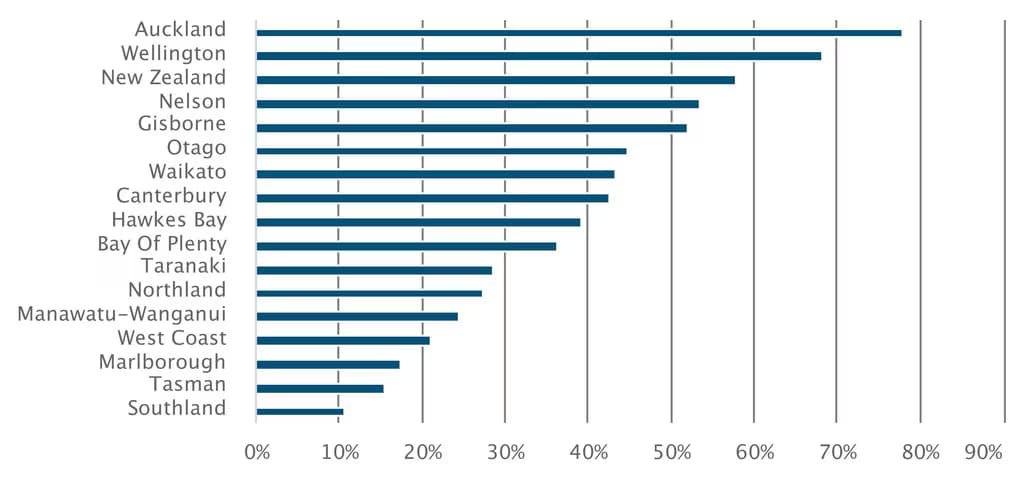
- Nearly 78% of new dwelling consents issued in Auckland were for attached dwellings in the year to February. Wellington reported the second-highest ratio of attached dwelling consents, with 68% of new dwelling consents issued in the year to February for attached dwellings.
- Nelson, Gisborne, and Otago had the third- to fifth-highest proportion of attached dwelling consents in the February 2023 year, which is surprising given the lower urban density in these regions than in Waikato and Canterbury.
- High consent numbers for retirement units drove the elevated ratio of attached dwelling consents in Nelson, with retirement units representing 42% of total new dwelling consents in the February 2023 year. High consent numbers for townhouses lifted the share of attached dwellings in Gisborne and Otago, where townhouse consents were 45% and 34% of total new dwelling consents respectively in the year to February.
Higher-density dwellings consented in Nelson, Gisborne, and Otago
% of new dwelling consents that are attached dwellings
...and our reaction
- New dwelling consents continued to soften in February, declining for the third consecutive month on a seasonally adjusted basis. Annual consents have now fallen to 48,257, a 3.3% decline from this time last year.
- The share of consents which are issued for attached dwellings has grown swiftly over the last two years, from around 41% of new dwellings consents in early 2020 to nearly 58% in early 2023. The main drivers of this trend have been high house prices, rising interest rates, and high building cost inflation, which have made housing generally more unaffordable. Attached dwellings tend to be smaller in size and therefore more affordable.
- The trend towards higher-density attached dwellings is starting to spread outside the major urban centres of Auckland and Wellington, with attached dwellings comprising a greater share of total dwelling consents in 15 out of 16 regions, compared to February 2022.
- We still expect slower economic activity in 2023 and 2024 will limit the number of dwelling consents issued, with struggling households demanding fewer new houses, and rising interest rates and falling property prices cutting into developers’ profits.
Latest updates
Premium

Residential building consents
Residential consents fall 3.6% in June
Mon 3 Aug 2026
Monthly
40,581 Annual consents over the June 2026 year
19% June 2026 consents over the June 2026 year3.6% June 2026 consents from May on a seas. adj. basisPremium
Residential building consents
Residential consents fall 4.0% in May
Thu 2 Jul 2026
Monthly
 39,737 Annual consents over May 2026 year4.0% May 2026 consents from April on a seas. adj. basis22%pa Townhouse consents over May 2026 year
Residential building consents
Residential consents jump up 11% in April
Wed 3 Jun 2026
Monthly
39,087 Annual consents over April 2026 year11% April 2026 consents from March on a seas. adj. basis19%pa Multi-unit consents over April 2026 yearResidential building consents
Residential consent momentum trends sideways
Fri 1 May 2026
Monthly
37,813 Annual consents over March 2026 year 3,300pm Consents trend sideways on a seas. adj. basis14%pa Townhouse consents over March 2026 year