Residential building consents
Largest annual decline in standalone consents in over a decade
1 Mar 2023

Our take on the latest Residential building consents (Wed 1 Mar 2023)
Annual dwelling consents
49,480

As of January 2023
Standalone house consents down 18% in year to January 2023
Year-end townhouse consent growth eases to 26%pa, softest since 2019
The key numbers...
- Residential consents totalled 2,777 in January 2023, a decline of 1.5% from December 2022 after adjusting for seasonality.
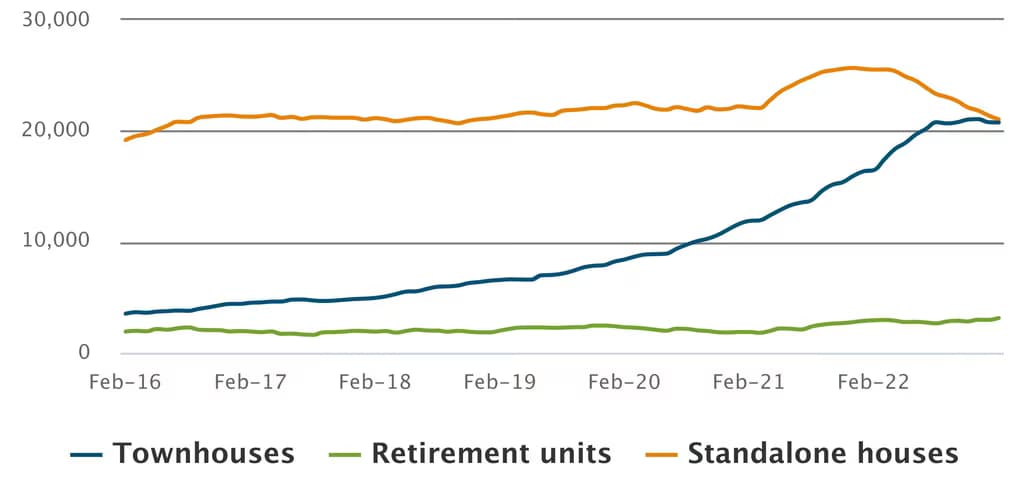
- Attached dwellings surpassed 57% of annual consents in January as standalone consents continue to soften. Standalone consents fell 26%pa in January, bringing the annual total to 21,032 and dragging year-end standalone decline to its largest in 12 years.
- Non-house consents grew 22%pa in January 2023, reversing their 10%pa decline in December. Apartment and retirement consents were surprisingly strong, up 80%pa and 98%pa respectively. However, townhouse consents maintained their slight downward trend, falling by 3.0%pa in January.
- January was a particularly strong month for non-house consents in Taranaki, Gisborne, and Manawatu-Whanganui. However, non-house consents in Auckland and Waikato (which together account for over 50% of New Zealand’s non-house consents) maintained downwards momentum, declining 2.0%pa and 13%pa respectively.
- Renovation work is continuing to decline, with a 5.6%pa fall in the value of alterations and additions consents in the three months to January 2023. Taking building cost inflation into account, this figure suggests an even steeper fall in the volume of alterations.
Standalones declining, townhouses plateauing
Annual running totals
...and our reaction
- Despite a bounce in non-house consents in January, overall consents continue to decline. With standalone house consents recording their largest annual decline in over a decade, there is no doubt that residential builds are losing popularity as the housing market cools and rising interest rates make construction increasingly unaffordable.
- House prices are now more than 16% lower than their peak in November 2021, and with residential building cost inflation still running at 13%pa, the attractiveness of constructing new dwellings is reducing significantly. Year-end townhouse consent growth eased to 26.0%, the softest annual growth rate since November 2019, during the pandemic.
- We can expect non-houses to at least maintain their share of total consents, with townhouses becoming an increasingly favourable option compared to standalones as difficult economic conditions force buyers to tone down their aspirations.
- Retirement consents remain significantly above pre-pandemic levels and will continue to support non-house consents, as operators expand their capacity in line with New Zealand’s aging population.
Latest updates
Premium

Residential building consents
Residential consents fall 3.6% in June
Mon 3 Aug 2026
Monthly
40,581 Annual consents over the June 2026 year
 19% June 2026 consents over the June 2026 year3.6% June 2026 consents from May on a seas. adj. basis
Premium
Residential building consents
Residential consents fall 4.0% in May
Thu 2 Jul 2026
Monthly
 39,737 Annual consents over May 2026 year4.0% May 2026 consents from April on a seas. adj. basis22%pa Townhouse consents over May 2026 year
Residential building consents
Residential consents jump up 11% in April
Wed 3 Jun 2026
Monthly
39,087 Annual consents over April 2026 year11% April 2026 consents from March on a seas. adj. basis19%pa Multi-unit consents over April 2026 yearResidential building consents
Residential consent momentum trends sideways
Fri 1 May 2026
Monthly
37,813 Annual consents over March 2026 year 3,300pm Consents trend sideways on a seas. adj. basis14%pa Townhouse consents over March 2026 year