
Our take on the latest Retail trade survey (Mon 27 Feb 2023)


Retail sales volumes down 0.6% in December quarter (seasonally adjusted)
Stock totals up 4.1% from September quarter (seasonally adjusted)
Retail trade prices were 9.9% higher than December 2021 quarter
The key numbers...
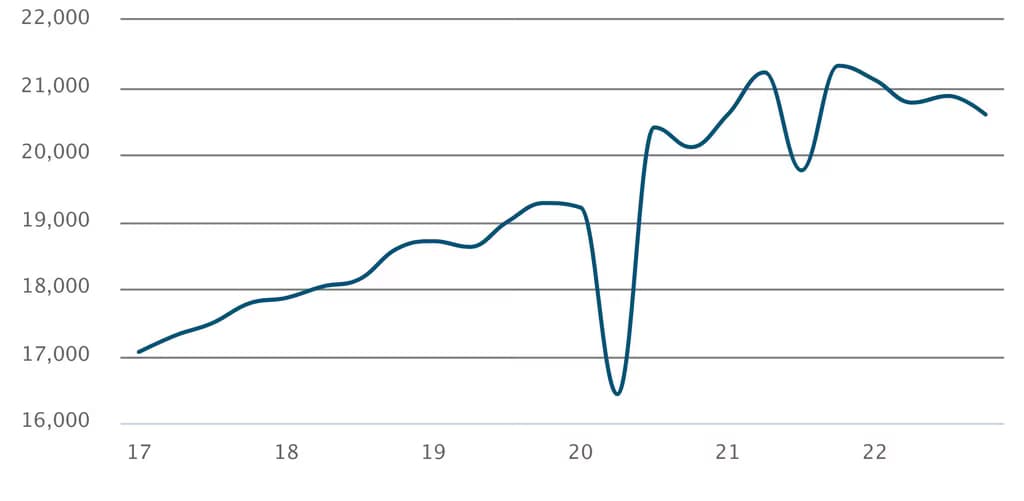
- Retail sales totalled $30.7b in the December 2022 quarter, a 0.6% decline in sales activity from the September quarter after accounting for rising prices and seasonal effects.
- Core retail sales volumes, a measure which excludes motor vehicles and fuel retailing, declined further, down 1.3% from the previous quarter (seasonally adjusted).
- Fuel sales volumes increased strongly in the December quarter, up 2.6% from the September quarter, which buoyed total sales volumes. Accommodation and food and beverage services sales volumes also rose in the December quarter, up 2.3% and 2.4% respectively (all figures seasonally adjusted).
- Supermarket sales volumes eased slightly from the September quarter, falling 0.5% in the December quarter. Furniture and clothing sales volumes also fell in the December quarter, down 5.2% and 2.9% respectively (all figures seasonally adjusted).
- Stock totals continued to climb in December, up 4.1% from the previous quarter on a seasonally adjusted basis, which took total stock values to $9.8b. However, stock totals were only up 8.6% from December 2021, while prices were up 9.9%, suggesting a decline in the real value of stock over the last 12 months.
Retail sales volumes start to edge down
Retail sales volumes (seasonally adjusted), $m (Sep-10 prices)
...and our reaction
- The lower spending volumes in the December quarter suggests the Reserve Bank’s tighter monetary settings could be starting to have the desired effect, as higher mortgage servicing costs for some households will see them reduce spending in other areas. Broad-based inflation will also be driving down sales volumes, with fixed or constrained household budgets being eroded in several areas, further softening retail spending volumes.
- The mixed performance across retail sectors highlights the uneven impact of monetary policy, making it clear some household budgets are being squeezed more than others. For example, lower sales volumes of furniture in the December quarter indicates households may be cutting back on discretionary spending, but higher spending volumes on food and beverage services suggests the opposite – though a recovery for the tourism industry may be a contributing factor to stronger activity here.
- We anticipate interest rates and prices will continue to rise in 2023, which will continue to limit retail sales volumes. Eventually, the lower spending volumes will start to cool the economy, which should filter through to ease inflationary pressures.
Latest updates
Premium

Retail trade survey
Core retail volumes grow slower as consumers adjust to elevated fuel prices
Mon 24 Aug 2026
Quarterly
 -0.5% Total retail sales volumes in the June 2026 quarter (seas. adj.)+0.7% Core retail sales volumes in the June 2026 quarter (seas. adj.)+6.5%pa South Island core retail sales in the June 2026 quarter
Premium
Retail trade survey
Anxious consumers pull back on discretionary spending
Fri 22 May 2026
Quarterly
1.0% Core retail sales volumes in the March 2026 quarter (seas. adj.)8 of 13 core industries recorded quarterly rises (seas. adj.)-4.8% Clothing, footwear in the March 2026 quarter (seas. adj.)Retail trade survey
Retail spending continues to strengthen
Mon 23 Feb 2026
Quarterly
1.5% Core retail sales volumes in December (seas. adj.)11 of 13 core industries recorded quarterly rises (seas. adj.)South Island continues to lead the recoveryRetail trade survey
Retail spending recovery gaining traction
Thu 27 Nov 2025
Quarterly
Core retail sales volumes up 1.2% in September (seas. adj.) Seven of 13 core industries saw quarterly rises (seas. adj.)North Island growth starting to follow the South’s lead