Residential building consents
New dwelling consents continue to ease in December
2 Feb 2023

Our take on the latest Residential building consents (Thu 2 Feb 2023)
Annual dwelling consents
49,538


As of December 2022
New dwelling consents down 7.2% from November 2022 (seasonally adjusted)
Standalone house consents down 24%pa in December 2022
The key numbers...
- There were 3,457 new dwelling consents issued in December 2022, a 7.2% decline from November after adjusting for seasonal effects.
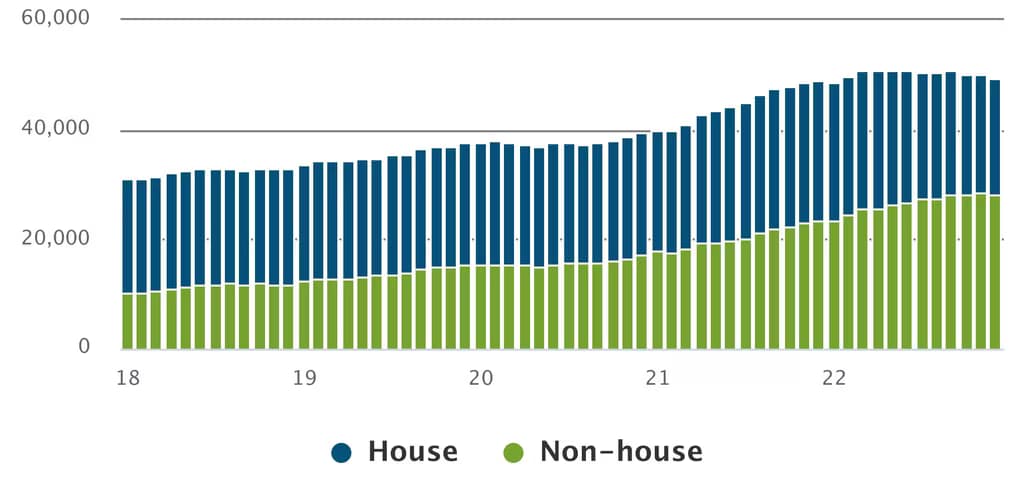
- December dwelling consents were 16% lower than this time last year, taking annual dwelling consents to 49,538, the lowest annual total since January 2022.
- Consents for standalone houses have been softening since November 2021, and in December 2022 were 24% lower than the prior year.
- Non-house consents had initially held up as standalone consents declined, but have now started to weaken too, with non-house consents in December 2022 declining 10% from a year ago.
- Nevertheless, annual non-house consents are still strong, with annual townhouse, retirement, and apartment consents up 27%, 7.6%, and 4.6%pa respectively.
- The strength of non-house consents in the last 12 months has supported consent numbers in New Zealand’s larger urban areas, with annual consents in Christchurch, Wellington, and Auckland increasing 15%, 5.9%, and 3.8%pa respectively, while nationwide annual consents only increased 1.1%pa.
Standalone still softer than non-house consents, but overall activity declining
Annual residential building consents
...and our reaction
- Consents continued to decline from their peak reached in early 2022, led by fewer standalone house consents, and non-house consents have started to soften too. We expect consents will decline further as the substantial correction in the housing market and high interest rates dampen the outlook for residential construction.
- Nationwide house prices continued to fall in December, taking prices 15% below their November 2021 peak, and house sales remain near record lows.
- Higher interest rates, cost-of-living pressures, and a weakening labour market will continue to squeeze household budgets and slow the rate of household formation throughout the next two years, limiting demand for new dwellings and dragging residential consent numbers lower.
- The larger share of non-house consents is likely to be a sustained trend as overall consents decline, with tougher economic conditions making the relative affordability of townhouses more appealing to households.
Latest updates
Premium

Residential building consents
Residential consents fall 3.6% in June
Mon 3 Aug 2026
Monthly
40,581 Annual consents over the June 2026 year
 19% June 2026 consents over the June 2026 year3.6% June 2026 consents from May on a seas. adj. basis
Premium
Residential building consents
Residential consents fall 4.0% in May
Thu 2 Jul 2026
Monthly
 39,737 Annual consents over May 2026 year4.0% May 2026 consents from April on a seas. adj. basis22%pa Townhouse consents over May 2026 year
Residential building consents
Residential consents jump up 11% in April
Wed 3 Jun 2026
Monthly
39,087 Annual consents over April 2026 year11% April 2026 consents from March on a seas. adj. basis19%pa Multi-unit consents over April 2026 yearResidential building consents
Residential consent momentum trends sideways
Fri 1 May 2026
Monthly
37,813 Annual consents over March 2026 year 3,300pm Consents trend sideways on a seas. adj. basis14%pa Townhouse consents over March 2026 year