
Our take on the latest Employment indicators (Mon 30 Jan 2023)



Filled jobs down 0.1% in December (seasonally adjusted)
Services jobs unchanged in December (seasonally adjusted)
Retail trade employment flat, agriculture sector down 5.6%pa
The key numbers...
- Filled jobs numbers edged down slightly in December 2022, with a 0.1% fall (seasonally adjusted) the first monthly decline since March 2022.
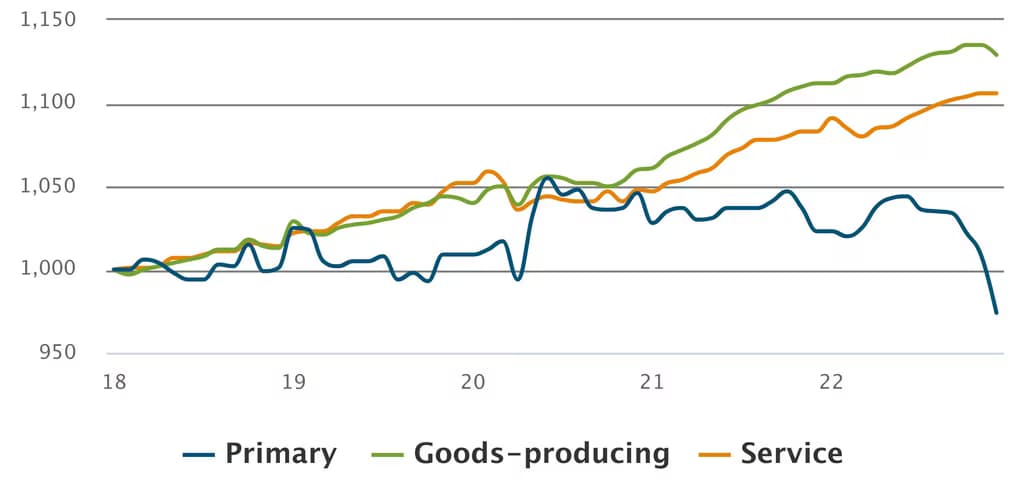
- Primary industry job numbers fell a heavy 3.4% in December, the worst monthly fall since late 2006, although monthly figures are regularly revised. Goods-producing industries (manufacturing, energy/water/waste, and construction) saw a 0.6% monthly fall – the first since October 2020, and the worst since the original Level 4 lockdown in early 2020 (all figures seasonally adjusted).
- Filled jobs in services industries stood still in December (seasonally adjusted), the weakest performance since March 2022.
- Employment in the retail trade industry was flat year-on-year in December 2022, with other services industries showing a continued slowdown in employment growth. Growth for professional services jobs has slowed from a peak of 9.0%pa in early 2022 to 3.3%pa in December 2022.
- The growth in earnings per filled job remains high, at 6.4%pa on average over the year to December 2022. There are signs that wage growth might be plateauing, but it’s certainly not slowing yet in any discernible way.
Filled jobs levelling off?
Monthly filled jobs (seasonally adjusted), Index, Jan-18 = 1,000, by industry grouping
...and our reaction
- The first fall in filled jobs (seasonally adjusted) in nine months is an important milestone, and it adds to growing evidence that the economy is starting to level off after a sustained period of upward momentum.
- However, we’re cautious about reading too much into it given the revisions to filled jobs data over time, and we also note that levelling off is still a long way from creating some spare capacity in the labour market.
- Job ads are now down 21% from their recent peak in May 2022 (seasonally adjusted), but they are still 15% higher than at the end of 2019. The data shows that there’s still a lot of demand for workers, but also that businesses are moderating their requirements ahead of more challenging economic times.
- Primary sector employment remains considerably weaker, but it’s the plateauing in services employment that we will watch the most. The flat annual growth in retail trade employment matches softer sales in December.
- Our current view is that businesses are looking ahead to a more difficult 2023 and taking a more cautious hiring approach, with concerns that they might have enough work to justify additional workers in a few months’ time. Some roles might also have been unfilled for so long that businesses have adapted to not having these workers around.
Latest updates
Premium

Employment indicators
Further weak employment recovery
Tue 28 Jul 2026
Monthly
 0.1% Filled jobs rose in June 2026 (sa)0.6%pa Filled jobs were up from June 2025
 1.5%pa South Island filled jobs incre from June 2025
Premium
Employment indicators
Public sector leads job gains
Mon 29 Jun 2026
Monthly
0.3% Filled jobs in May (sa)0.1% Filled jobs in April (sa)0.7% Filled jobs from May 2025Employment indicators
Healthcare leads job growth
Thu 28 May 2026
Monthly
0.2% Filled jobs in April (sa)0.5% Filled jobs from April 20255,527 Healthcare jobs over the year to AprilEmployment indicators
Let’s hear it for the South
Tue 28 Apr 2026
Monthly
0.3% Filled jobs in March (sa)0.2% Filled jobs in February (sa)1.5%pa South Island jobs in March