
Our take on the latest Residential building consents (Tue 1 Nov 2022)
Annual dwelling consents
50,732


As at September 2022
Standalone house consents up 0.6% from August (seasonally adjusted)
Attached dwellings make up over 55% of consents in the last year
The key numbers...
- Residential consents totalled 4,600 in September, a 3.8% increase from August and the strongest result in six months after adjusting for seasonal effects.
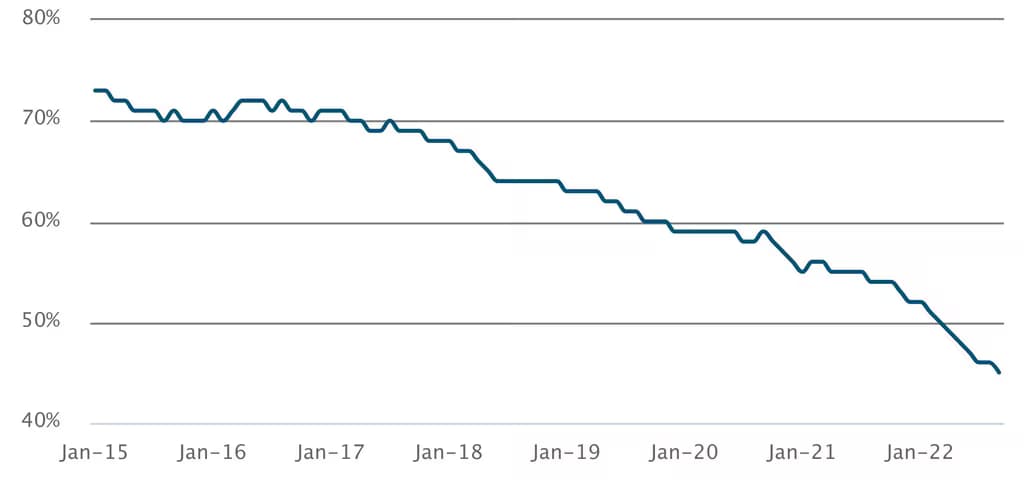
- Consents for standalone houses remain softer than they were between late 2020 and early 2022. Despite the small rise in house consents between August and September, the monthly total was still down 15% from a year ago, and the 22,697 standalone consents issued in the last year made up only 45% of total residential consents.
- Townhouses consents were up 6.2% from September 2021, a modest recovery after August’s drop, which was the first decline in three years.
- However, there was a large number of apartment consents in September, with 585 apartments in Auckland taking national apartment consents to 778 for the month. This is the highest monthly total for apartment consents since March 2005.
- Taranaki has seen its consent numbers decline most strongly over the September 2022 quarter, with residential consents falling 52% compared to the same period in 2021. Other areas experiencing strong decreases in consent numbers include Gisborne, Hawke’s Bay, Southland, and Marlborough. One exception is Nelson, which experienced 142%pa growth in new residential consents in the last three months.
- Activity continues to grow steadily in Auckland and Christchurch, with residential consents in the three months to September 2022 up 6.8% and 4.2%pa respectively. However, consents are starting to ease in Wellington, with the number of consents down 7.8% compared to the September 2021 quarter.
Popularity of standalones continues to decline
Annual % share of dwelling consents for standalone houses
...and our reaction
- Residential consent numbers were steady in September, despite declining prices and sales activity in the real estate market. Residential consents in Auckland and Christchurch continued to hold up, with the strongest declines occurring in the provincial areas of New Zealand.
- The shift away from consents for standalone houses has accelerated in 2022, contributing to our expectation that annual standalone consents would decline swiftly until early 2024. Rapidly rising interest rates are lifting mortgage servicing costs, which is limiting the affordability of standalone houses. Additionally, the growing popularity of attached dwellings could also be due to greater demand for intensification in urban centres and decreases in the average household size also possible drivers.
- We expect total residential consent numbers will begin declining in the next 3-6 months as the substantial correction in the housing market begins to filter through to consenting activity. We anticipate consents will ease until early 2024, where they will stabilise at a new lower level of around 30,000pa. Additionally, capacity constraints continue to be an issue in residential construction and across the economy, so it remains to be seen how many of the 50,000 residential consents issued in the last year will be completed.
Latest updates
Premium

Residential building consents
Residential consents fall 3.6% in June
Mon 3 Aug 2026
Monthly
40,581 Annual consents over the June 2026 year
19% June 2026 consents over the June 2026 year 3.6% June 2026 consents from May on a seas. adj. basis
Premium
Residential building consents
Residential consents fall 4.0% in May
Thu 2 Jul 2026
Monthly
39,737 Annual consents over May 2026 year4.0% May 2026 consents from April on a seas. adj. basis22%pa Townhouse consents over May 2026 yearResidential building consents
Residential consents jump up 11% in April
Wed 3 Jun 2026
Monthly
39,087 Annual consents over April 2026 year11% April 2026 consents from March on a seas. adj. basis19%pa Multi-unit consents over April 2026 yearResidential building consents
Residential consent momentum trends sideways
Fri 1 May 2026
Monthly
37,813 Annual consents over March 2026 year 3,300pm Consents trend sideways on a seas. adj. basis14%pa Townhouse consents over March 2026 year