
Our take on the latest Employment indicators (Wed 28 Sept 2022)

Filled jobs in August up 2.4%pa
Earnings per job up in year to August up 7.0%pa
Employment of 65+ aged workers up 5.9%pa
The key numbers...
- The number of filled jobs rose 2.4%pa in August 2022. Job numbers were up 0.4% from July 2022 (seasonally adjusted), which is consistent with the trend of solid growth since April this year. The monthly result was driven by 0.7% and 0.5% rises in goods-producing and service industries jobs respectively, and came despite a 1.1% fall in jobs in primary industries.
- Job growth was positive across all regions, with the fastest growth since August 2021 in Canterbury (3.3%pa) and Gisborne (3.0%pa).
- Jobs in the primary industries and arts and recreation have dropped from August 2021, but there have been impressive gains for the electricity, gas, and waste service industry (up 8.0%pa) and the manufacturing industry (up 3.2%pa). Jobs in the transport and postal sector are up 5.2%pa, the strongest growth since January 2022.
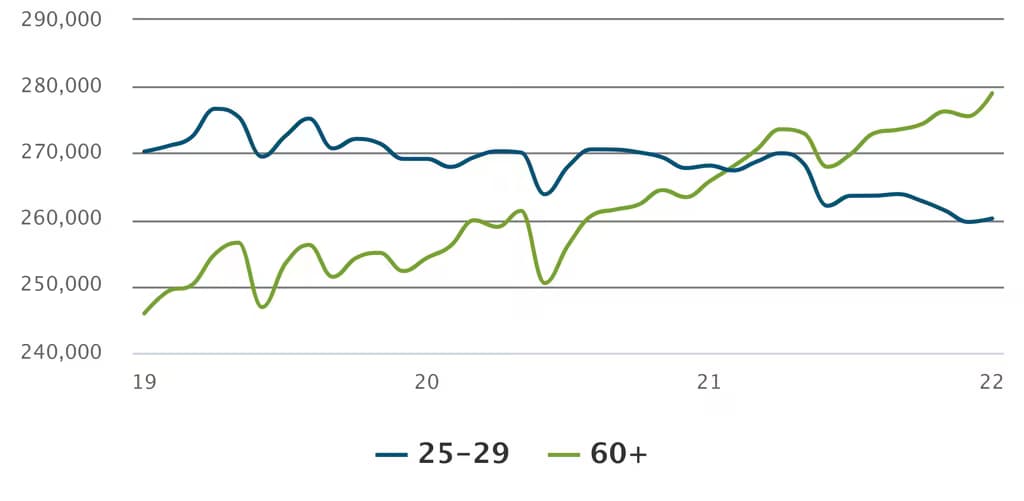
- Employment for workers in their mid-to-late 20s was down 3.0%pa from a year ago, and employment of 45-49 year old workers edged down 0.7%pa as well. However, these results are stronger than population growth in these age brackets over the last year, at -4.0% and -2.6%pa respectively.
- Youth employment has not stalled in its momentum, with filled jobs for 15-19 year olds up 17%pa.
- Employment of workers aged 60-64 is up 4.3%pa, and employment in the over 65 bracket is up 5.9%pa, possibly as the Older Workers Employment Action Plan begins to reap benefits. Population growth among over-60s was 2.7% in the last year.
- Earnings per filled job in the 12 months to August were up 7.0%pa, the strongest result since May.
Growth in 60+ workers offsets loss of mid-20's, stretching capacity
Total filled jobs
...and our reaction
- The economy is showing remarkable flexibility and ability to expand, despite ongoing indications that the labour market is at capacity.
- Businesses are struggling to find workers, especially as the number of 25-29-year-olds declines, and migrant work visas numbers remain low. Employers look to be increasingly turning to youth and older workers to fill the gaps in the workforce.
- Border closures and demand for workers in higher-paying industries have contributed to significant job losses in some industries, with 2,300 fewer jobs in agriculture and forestry than a year ago, and 2,000 fewer jobs in accommodation and food services. Job growth in other industries is otherwise positive but slow.
- Annual earnings growth is consistently strong, and we expect this growth to remain elevated into 2023 as businesses continue competing to hire and retain workers.
Latest updates
Premium

Employment indicators
Further weak employment recovery
Tue 28 Jul 2026
Monthly
 0.1% Filled jobs rose in June 2026 (sa)0.6%pa Filled jobs were up from June 20251.5%pa South Island filled jobs incre from June 2025
Premium
Employment indicators
Public sector leads job gains
Mon 29 Jun 2026
Monthly
0.3% Filled jobs in May (sa) 0.1% Filled jobs in April (sa)0.7% Filled jobs from May 2025
Employment indicators
Healthcare leads job growth
Thu 28 May 2026
Monthly
0.2% Filled jobs in April (sa)0.5% Filled jobs from April 20255,527 Healthcare jobs over the year to AprilEmployment indicators
Let’s hear it for the South
Tue 28 Apr 2026
Monthly
0.3% Filled jobs in March (sa)0.2% Filled jobs in February (sa)1.5%pa South Island jobs in March