
Our take on the latest Retail trade survey (Fri 26 Aug 2022)


Retail sales volumes drop 2.3% (seasonally adjusted)
Total value of retail spending flat (seasonally adjusted)
Notable falls in home-based spending
The key numbers...
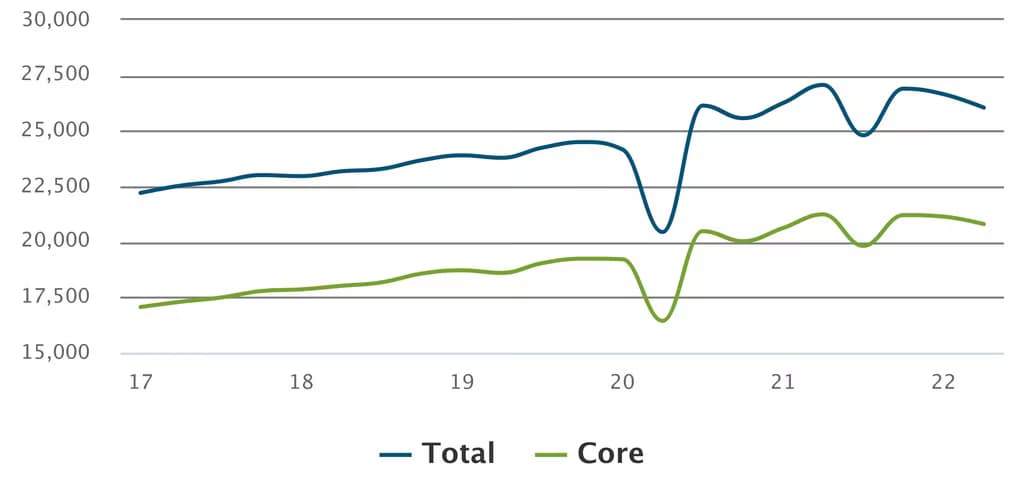
- Retail sales volumes in the June quarter declined at their fastest pace since the Global Financial Crisis (excluding lockdown periods), falling 2.3% (seasonally adjusted).
- The substantial fall was considerably worse than forecast, with a market consensus of a 1.7% rise ahead of the release.
- Lower car and fuel purchases drove down the total, falling 6.7% and 2.3% respectively. Excluding automotive categories, core retail sales volumes declined 1.6%, the fourth-worst fall on record (after COVID-induced drops in the June 2020, December 2020, and September 2021 quarters).
- Homeware and building supply sales volumes dropped the most, down 8.0% and 5.3% respectively in the June quarter (seasonally adjusted).
- Retail sales across the mid and lower-North Island led the decline in spending, with quarterly falls in volumes across Bay of Plenty, Gisborne, Taranaki, Manawatū-Whanganui, and Wellington. Nelson and Marlborough retail sales also eased.
Retail trade worse than we all thought
Retail sales volumes (seasonally adjusted), $m (Sep 2010 prices)
...and our reaction
- Retail sales volumes in the June quarter were decidedly weak, and considerably worse than expectations. The total value of sales was flat in the quarter, meaning that once adjusted for inflation, Kiwis are paying more to get less at the shop.
- The fall in core spending volumes reinforces our view of a relatively weak economic growth figure for the June 2022 quarter. However, our current view is that the early stages of a revival in tourism will counter other general economic weakness and keep quarterly growth in positive territory.
- Worryingly, the retail trade data also reinforces a looming challenge for the economy. Economic growth is definitely slowing, in line with what the Reserve Bank will want to see. But retail cost pressures still look to be accelerating, creating concerns of persistent inflation that will require continued interest rate rises, even as economic activity is subdued.
Latest updates
Premium

Retail trade survey
Core retail volumes grow slower as consumers adjust to elevated fuel prices
Mon 24 Aug 2026
Quarterly
-0.5% Total retail sales volumes in the June 2026 quarter (seas. adj.) +0.7% Core retail sales volumes in the June 2026 quarter (seas. adj.)+6.5%pa South Island core retail sales in the June 2026 quarter
Premium
Retail trade survey
Anxious consumers pull back on discretionary spending
Fri 22 May 2026
Quarterly
1.0% Core retail sales volumes in the March 2026 quarter (seas. adj.)8 of 13 core industries recorded quarterly rises (seas. adj.)-4.8% Clothing, footwear in the March 2026 quarter (seas. adj.)Retail trade survey
Retail spending continues to strengthen
Mon 23 Feb 2026
Quarterly
1.5% Core retail sales volumes in December (seas. adj.)11 of 13 core industries recorded quarterly rises (seas. adj.)South Island continues to lead the recoveryRetail trade survey
Retail spending recovery gaining traction
Thu 27 Nov 2025
Quarterly
Core retail sales volumes up 1.2% in September (seas. adj.) Seven of 13 core industries saw quarterly rises (seas. adj.)North Island growth starting to follow the South’s lead