
Our take on the latest Employment indicators (Mon 31 Jan 2022)


Filled jobs rise 0.2% (seasonally adjusted) in December
Construction workforce tops 200,000 for the first time
Year-end earnings growth at record 9.9%pa
The key numbers...
- Filled job numbers rose 0.2% in December (seasonally adjusted), extending the current run of jobs growth to 13 months. This stretch is the longest period of monthly jobs growth since 15 months of growth in 2000/01.
- New Zealand added 87,472 additional jobs between December 2020 and December 2021.
- Total earnings rose 9.9%pa on average over 2021, the fastest growth since mid-2005. Earnings per filled job rose 7.2%pa over the same period, with this measure accelerating over the last few months of 2021.
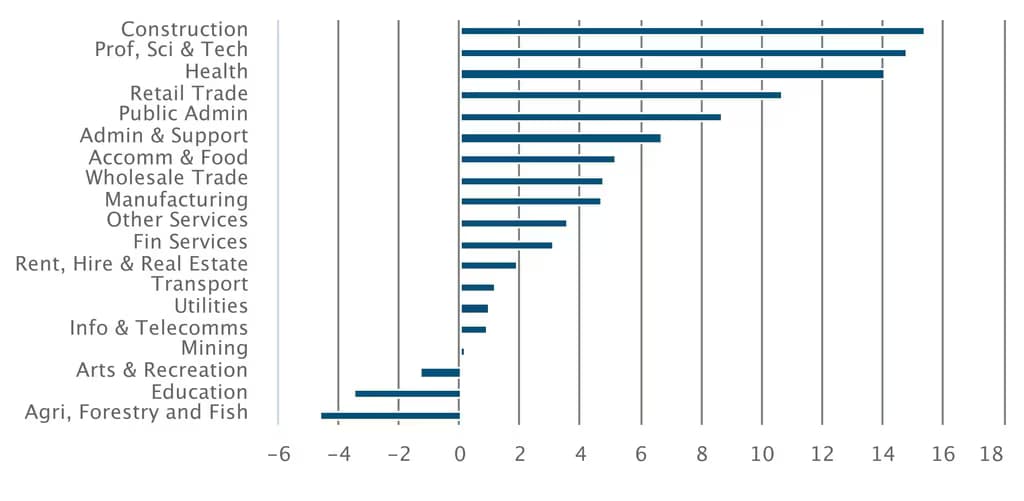
- The construction industry hit a new milestone, rising above 200,000 workers in December. Construction’s 15,430 additional jobs (up 8.3%) was the largest across all industries.
- Professional service jobs rose 8.5%pa in December, the largest percentage gain of any industry. In contrast, employment growth in the accommodation and food services industry slowed noticeably, and both the primary sector and the arts and recreation industry recorded falls of more than 3%pa.
- The upper North Island posted strong job growth results, with job numbers in Northland up 5.3%, Waikato up 4.7%, and Auckland up 4.2%.
Annual gain of over 87,000 jobs in 2021
Filled jobs by industry, 000s, national, December 2021
...and our reaction
- The New Zealand economy continues to add more jobs, with labour market pressures becoming ever more intense. Given continued strength in job ads numbers and high demand for workers being reported, we’d expect to see these job gains continue in 2022.
- The sustained run of job gains over the last year reinforces the general strength of the labour market, with the Delta outbreak only providing a slight change of pace, rather than wholesale job losses.
- However, not all industries are doing well. The slowdown in accommodation and food services employment growth was considerable, as was the fall in arts and recreation employment. Both sectors are limited at the Red traffic light setting, and with heightened nervousness from consumers, Omicron looks likely to make life difficult for these industries during 2022.
- The primary sector is also still struggling to find enough staff, with high commodity prices suggesting that the fall in employment is not due to a lack of demand for workers.
- Wage growth is set to accelerate further during 2022. Difficulties finding and keeping staff means that businesses are having to reach deeper into their wallet to afford talent.
Latest updates
Premium

Employment indicators
Further weak employment recovery
Tue 28 Jul 2026
Monthly
 0.1% Filled jobs rose in June 2026 (sa)0.6%pa Filled jobs were up from June 20251.5%pa South Island filled jobs incre from June 2025
Premium
Employment indicators
Public sector leads job gains
Mon 29 Jun 2026
Monthly
0.3% Filled jobs in May (sa) 0.1% Filled jobs in April (sa)0.7% Filled jobs from May 2025
Employment indicators
Healthcare leads job growth
Thu 28 May 2026
Monthly
0.2% Filled jobs in April (sa)0.5% Filled jobs from April 20255,527 Healthcare jobs over the year to AprilEmployment indicators
Let’s hear it for the South
Tue 28 Apr 2026
Monthly
0.3% Filled jobs in March (sa)0.2% Filled jobs in February (sa)1.5%pa South Island jobs in March