
Our take on the latest Residential building consents (Thu 13 Jan 2022)
48,522


Residential consents in the year to Nov 2021
3-month annual increase slows to 19%pa
Attached dwellings hit highest monthly share on record
The key numbers...
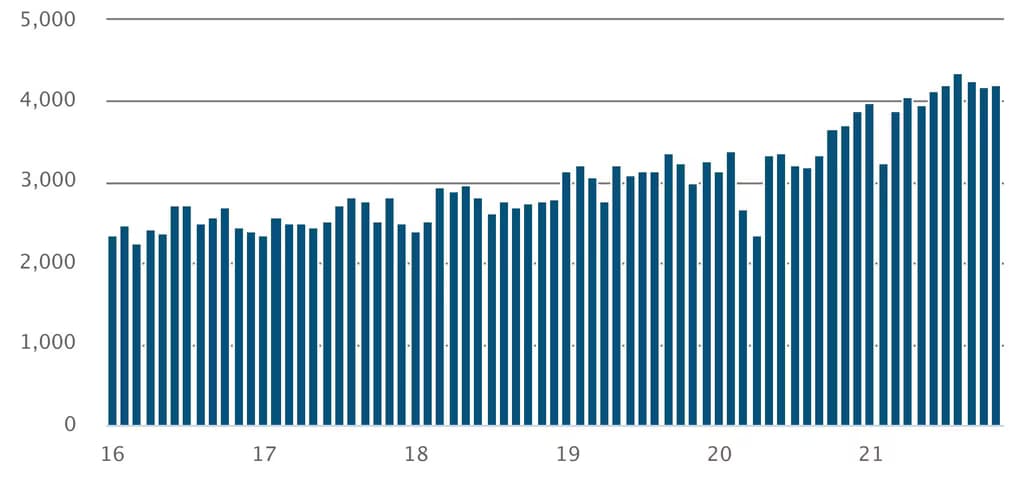
- Residential consents hit a new record monthly total of 4,688 in November. On a seasonally adjusted basis, consents rose 0.6% and snapped a two-month seasonally adjusted decline.
- Townhouses continue their rise, up 46%pa in November and recording their second highest monthly total on record. Growth in retirement units is also accelerating, reaching 49%pa in the month to take year-end growth to 51%pa. Apartments also rose, albeit at a slower 14%pa. Combined, attached dwellings accounted for 54.7% of monthly consents, the largest share on record.
- Standalone houses continue to be weaker, with a seventh straight month of seasonally adjusted falls. House consents grew just 3.4%pa in November, compared to 21%pa growth for all dwellings.
- Auckland consents rose above 20,000pa in November, with the city accounting for 41% of nationwide growth in consents over the last year. Waikato also made it above a milestone 5,000 annual consents.
- The value of consented alterations and additions (renovations) was up 22%pa over the 12 months to November, to $2.3b.
Consents rise, but momentum has started to wane
Monthly consents, seasonally adjusted
...and our reaction
- Although consent activity still seems to be roaring on the surface, momentum in growth is slowing as New Zealand approaches 50,000 consents a year. Getting through the backlog of consents, construction delays, and rising interest rates and materials costs are all contributing to this slowdown in momentum.
- That’s not to say that the residential market is weak – far from it. But the limits on further growth seem to be closer than might have been expected, if this levelling off is any indication.
- Capacity constraints continue to be felt across the sector. Higher costs, and the difficulties finding labour and materials, might now be influencing decisions on future projects, with a slower release of further consents possible.
- If the average annual increase in consents persists over the next two months, 50,000 consents will be reached, but with momentum waning, that growth might not be achievable.
- Medium-density townhouses continue to be the shining light, with recent legislative changes set to support this build type and help sustain growth. High land prices will also support more townhouses across the country. Retirement units are also recovering well, after hitting pause as COVID-19 broke out in 2020.
Latest updates
Premium

Residential building consents
Residential consents fall 3.6% in June
Mon 3 Aug 2026
Monthly
40,581 Annual consents over the June 2026 year
 19% June 2026 consents over the June 2026 year
 3.6% June 2026 consents from May on a seas. adj. basis
Premium
Residential building consents
Residential consents fall 4.0% in May
Thu 2 Jul 2026
Monthly
 39,737 Annual consents over May 2026 year4.0% May 2026 consents from April on a seas. adj. basis22%pa Townhouse consents over May 2026 year
Residential building consents
Residential consents jump up 11% in April
Wed 3 Jun 2026
Monthly
39,087 Annual consents over April 2026 year11% April 2026 consents from March on a seas. adj. basis19%pa Multi-unit consents over April 2026 yearResidential building consents
Residential consent momentum trends sideways
Fri 1 May 2026
Monthly
37,813 Annual consents over March 2026 year 3,300pm Consents trend sideways on a seas. adj. basis14%pa Townhouse consents over March 2026 year