
Our take on the latest Non-residential building consents (Tue 1 Jun 2021)
Value of non-res consents
$543m


In April 2021
Consent value fell 16% (seasonally adjusted)
Non-residential consents weak in urban centres
The key numbers...
- There was a total of $543m non-residential consents in April, which is 16% lower than March (seasonally adjusted). However, now that April 2020 has dropped out of the annual figures, the value of non-residential consents in the year to April 2021 is sitting higher than pre-pandemic levels.
- Non-residential consent activity is much higher compared with lockdown a year ago, with consent values over the previous three months being 50%pa higher. However, the value of non-residential consents is 12% lower when compared with the same pre-pandemic period in 2019.
- Education building consents were the standout build type, with $151m of consents in April 2021.
- Warehouse, retail, and office building consents have been weak recently, down 41%, 25% and 18% respectively, over the past three months when compared to the same period in 2019.
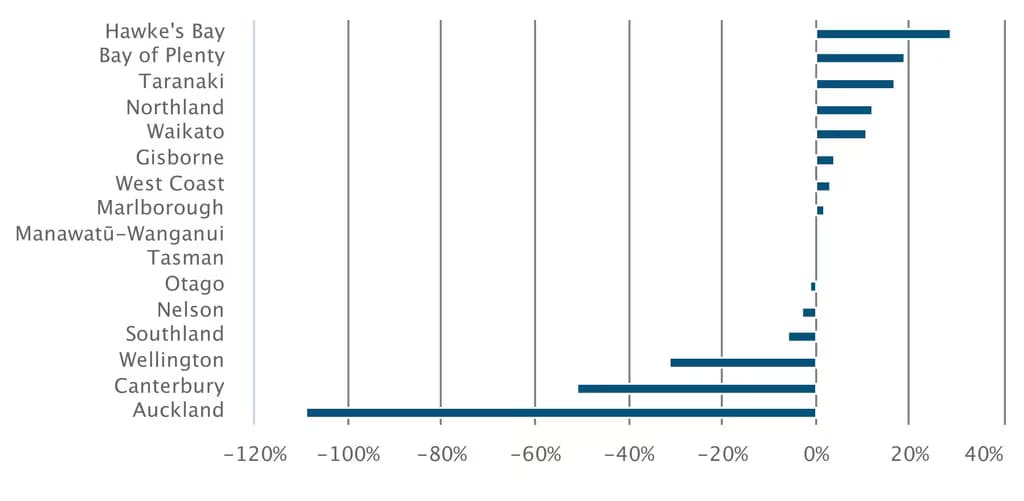
- Consent values in Auckland, Wellington and Canterbury have been weak recently, down 36%, 31% and 29% respectively, over the past three months when compared to the same period in 2019.
Urban centres a drag on non-res consents
3 months to April 2021 vs 3 months to April 2019
...and our reaction
- Non-residential consents have been showing considerable strength and momentum from August 2020 onwards, all things considered. As non-residential consents are relatively volatile, it is important not to place too much weight on one bad result.
- Non-residential consents have been catching up over the past year as many investors in early 2020 were scared off by the uncertainty of the pandemic.
- Our three main urban centres (Auckland, Wellington, and Christchurch) have been areas of relative weakness in recent times. However other parts of the country have been boosted by large projects, lifting the value of non-residential consents.
- A lot of resilience in non-residential consents in recent times can be attributed to public consents. The recent budget indicated further spending on education and health assets.
Latest updates
Premium

Non-residential building consents
Warehouses prevent further non-res falls in June
Mon 3 Aug 2026
Monthly
$701m Value of non-res consents in June 2026
7.4% Total non-res consents from May 2026 (seas adj) 37%pa Warehouse consents from June 2025
Premium
Non-residential building consents
Non-res consents weaker still in May
Thu 2 Jul 2026
Monthly
$789m Value of non-res consents in May 2026
19% Monthly consents from May 202549% Public sector consents from May 2025Non-residential building consents
Non-res consents mostly softer in April
Wed 3 Jun 2026
Monthly
$655m Value of non-res consents in April 2026
15% Monthly consents from April 2025Office and education consents at lowest monthly levels in 5-6 yearsNon-residential building consents
Consents strong in March, but shadow of conflict looms
Fri 1 May 2026
Monthly
$862m Value of non-res consents in March 2026
15% Monthly consents from Mar 2025$119m Hostel consents from Mar 2025