
Our take on the latest Residential building consents (Tue 30 Mar 2021)



New dwelling consents down 4.7%pa
Townhouse consents up 6.4%pa
Capacity constraints coming back to bite
The key numbers...
- New residential dwelling consents fell 4.7%pa in February, with 156 fewer approvals than a year prior. This single month of decline, however, could be just a slight blip in the trend, with approvals in the three months to February still up by 13%pa.
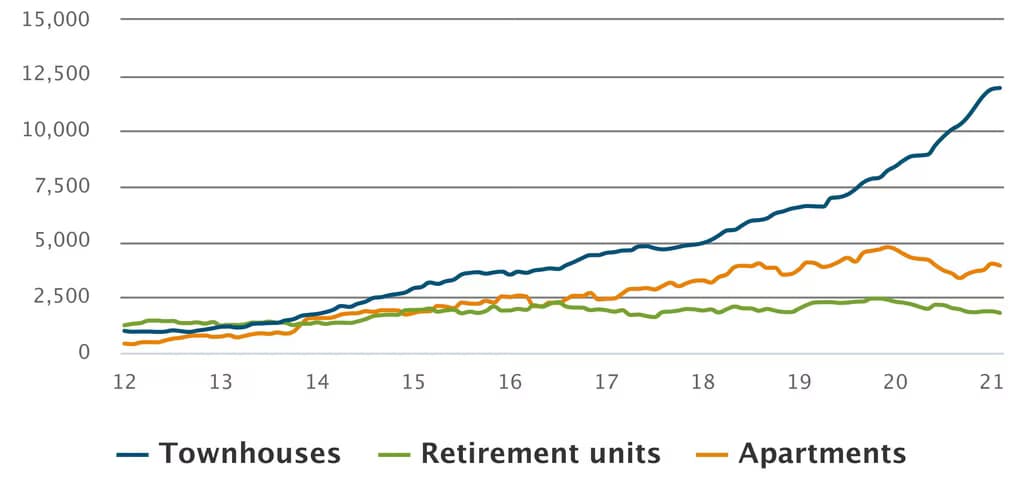
- Townhouse consents were still up in February, although growth was much weaker than in January (6.4%pa in February compared to 46%pa in January).
- The decline in overall consents in February was driven by a sharp drop in apartment and retirement approvals, with consents falling by 38% and 31%pa respectively. Standalone house consents also fell, down 2.5%pa.
- Wellington was responsible for most of the decline in residential consents, with 112 fewer approvals (-34%pa). Auckland had the next largest decline in the number of consents, with 56 fewer approvals (-4.5%pa).
Attached dwelling consents
Annual running total
...and our reaction
- Although February was a weak month for residential consents, it’s important not to read too much into one month. Annual approvals remain incredibly close to all-time highs, and New Zealand is still suffering a massive housing shortage and sky-rocketing house prices.
- Capacity constraints are becoming more critical for the industry, with approvals near record highs, strong levels of construction employment, and major supply chain disruptions. Supply chain disruptions and capacity pressures are evident in Carter Holt Harvey’s decision to stop supplying structural timber to Mitre 10 and ITM.
- The recently announced Housing Package will affect residential consents in two ways. Firstly, investor demand for existing housing is likely to soften, leading to slower house price inflation and therefore less appetite from developers to push ahead with new builds.
- However, the relatively favourable treatment of newly built investment property, compared to existing houses, will encourage investors to consider new builds and could push demand in this direction. Funding for infrastructure to increase the supply of ready and available land should also facilitate more residential building, although it is likely to be a couple of years before this initiative boosts housing supply.
Latest updates
Premium

Residential building consents
Residential consents fall 3.6% in June
Mon 3 Aug 2026
Monthly
40,581 Annual consents over the June 2026 year
19% June 2026 consents over the June 2026 year3.6% June 2026 consents from May on a seas. adj. basisPremium
Residential building consents
Residential consents fall 4.0% in May
Thu 2 Jul 2026
Monthly
 39,737 Annual consents over May 2026 year4.0% May 2026 consents from April on a seas. adj. basis22%pa Townhouse consents over May 2026 year
Residential building consents
Residential consents jump up 11% in April
Wed 3 Jun 2026
Monthly
39,087 Annual consents over April 2026 year11% April 2026 consents from March on a seas. adj. basis19%pa Multi-unit consents over April 2026 yearResidential building consents
Residential consent momentum trends sideways
Fri 1 May 2026
Monthly
37,813 Annual consents over March 2026 year 3,300pm Consents trend sideways on a seas. adj. basis14%pa Townhouse consents over March 2026 year