
Our take on the latest Residential building consents (Tue 1 Sept 2020)


New dwelling consents down 0.8%pa in July
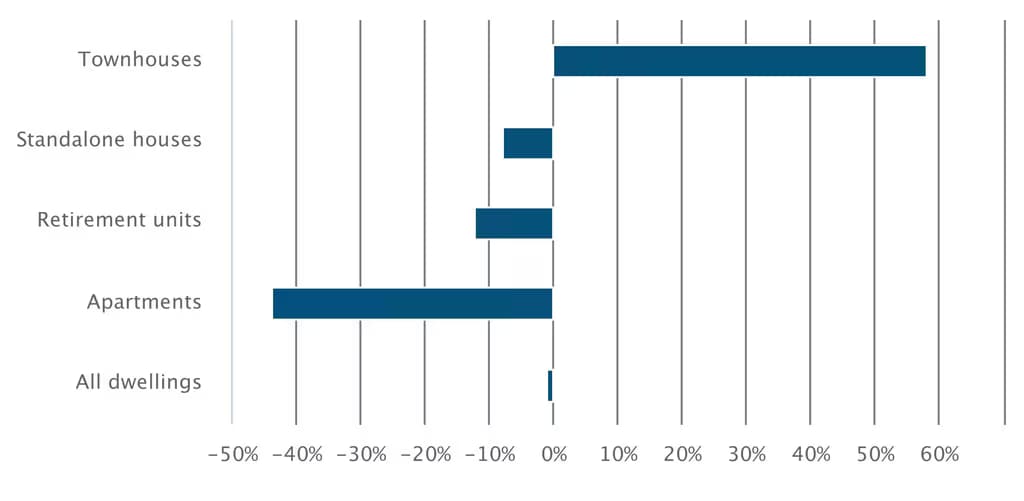
Townhouse consents rose, up 58%pa
Auckland consents rose in July, up 7.9%pa
The key numbers...
- Total new dwelling consents fell 0.8%pa in July 2020, with 3,391 dwelling consents issued, taking annual consents to 37,585. Standalone dwelling consents were the largest contributor to this decline, down 7.8%pa in July.
- However, there were still pockets of strength in residential consents, with townhouses continuing their strong run, with 1,030 townhouse consents in July (up 58%pa) - marking the second month in a row with more than 1,000 townhouses consented.
- Excluding townhouses, residential consents were softer. Apartment consents fell 44%pa, with retirement units slightly less negative, down 12%pa.
- Regional consenting activity was mixed, with a strong boost in Auckland (up 7.9%pa in July) and strong results in Hawke’s Bay and Manawatū-Whanganui offset by declines in the larger regions of Waikato, Wellington, and Canterbury.
Townhouses rise as other dwelling consents fall
Annual % change
...and our reaction
- Residential building consents softened slightly in July 2020, as the realities of a weaker economy sink in, and construction efforts pull back as funding limitations bite.
- Townhouse consent have remained a consistently strong performer throughout COVID-19, even as high-density apartments and low-density standalone house consents have fallen.
- Building levels in Auckland appear set to remain in a solid position, with consents in July 2020 representing the second highest number of monthly residential consents in the Super City on record.
- House building efforts are still set to decline as economic conditions remain softer and the effects of the COVID-19 pandemic limit credit availability. However, both medium density building nationally, and residential construction in Auckland, will provide some support in the near-term.
- With the housing market holding up better than expected, and interest rates set to fall further, upside risks remain to our building forecasts, but the general uncertainty of the economic outlook makes the path forward for construction hard to decipher.
Latest updates
Premium

Residential building consents
Residential consents fall 3.6% in June
Mon 3 Aug 2026
Monthly
40,581 Annual consents over the June 2026 year
19% June 2026 consents over the June 2026 year3.6% June 2026 consents from May on a seas. adj. basisPremium
Residential building consents
Residential consents fall 4.0% in May
Thu 2 Jul 2026
Monthly
 39,737 Annual consents over May 2026 year4.0% May 2026 consents from April on a seas. adj. basis22%pa Townhouse consents over May 2026 year
Residential building consents
Residential consents jump up 11% in April
Wed 3 Jun 2026
Monthly
39,087 Annual consents over April 2026 year11% April 2026 consents from March on a seas. adj. basis19%pa Multi-unit consents over April 2026 yearResidential building consents
Residential consent momentum trends sideways
Fri 1 May 2026
Monthly
37,813 Annual consents over March 2026 year 3,300pm Consents trend sideways on a seas. adj. basis14%pa Townhouse consents over March 2026 year