
Our take on the latest Non-residential building consents (Tue 5 May 2020)
Value of non-res consents
$432m

In March 2020
Total non-residential consents fell 36%pa in March
Hospital consents dropped 81%pa in March
The key numbers...
- The total value of non-residential consents dropped 20%pa in the March quarter, the largest quarterly fall since 2010. Most of this decline was due to a weak performance in the March month.
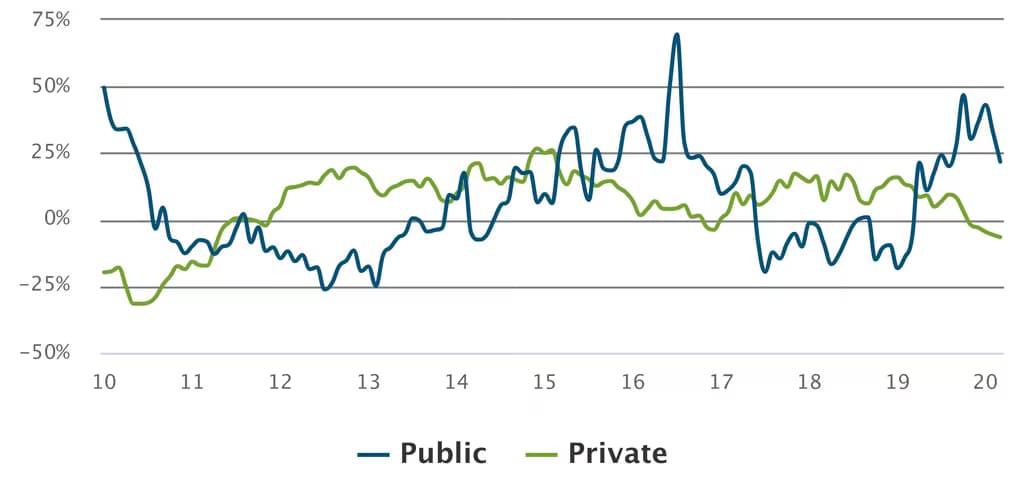
- Public consents were down 63%pa, as hospital and education building consents fell 81% and 70%pa respectively, although this drop in hospital building was in line with our expectations
- The value of private consents, which fluctuates less than public consents, was down 16%pa in the March quarter. Such weakness has not been seen since 2011.
- Office and retail building consents also had sizable declines, down 47% and 44%pa respectively, but office consents were about 11% stronger than we had forecast.
- Factories and hotels were the only subcategories to see increases in value, up 96%pa and 25%pa respectively, with total factory consents $34m higher than predicted.
- Auckland performed poorly again, declining by 44%pa (or $117m), contributing nearly half the decline in consent values nationwide.
Value of consents granted
Year-end % change
...and our reaction
- Investment intentions in non-residential building were weak in March, but March’s result is likely to be only a taste of what’s to come, as COVID-19 puts a stranglehold on the New Zealand economy.
- Further consents for hotels show that at the start of March people still saw potential in tourism, before the 14-day international traveller self-isolation became mandatory on March 14.
- Despite strength in hotel and hostel consents over the past year, many of these projects will not go ahead as planned, as a recovery in tourism activity will take several years.
- Despite weakness in hospital and education building in March, we expect these sectors to be more resilient, as investment in social infrastructure will be a good way to make up for some of the declines in activity that will occur in other parts of the construction industry.
Latest updates
Premium

Non-residential building consents
Warehouses prevent further non-res falls in June
Mon 3 Aug 2026
Monthly
$701m Value of non-res consents in June 2026
7.4% Total non-res consents from May 2026 (seas adj) 37%pa Warehouse consents from June 2025
Premium
Non-residential building consents
Non-res consents weaker still in May
Thu 2 Jul 2026
Monthly
$789m Value of non-res consents in May 2026
19% Monthly consents from May 202549% Public sector consents from May 2025Non-residential building consents
Non-res consents mostly softer in April
Wed 3 Jun 2026
Monthly
$655m Value of non-res consents in April 2026
15% Monthly consents from April 2025 Office and education consents at lowest monthly levels in 5-6 years
Non-residential building consents
Consents strong in March, but shadow of conflict looms
Fri 1 May 2026
Monthly
$862m Value of non-res consents in March 2026
15% Monthly consents from Mar 2025$119m Hostel consents from Mar 2025